
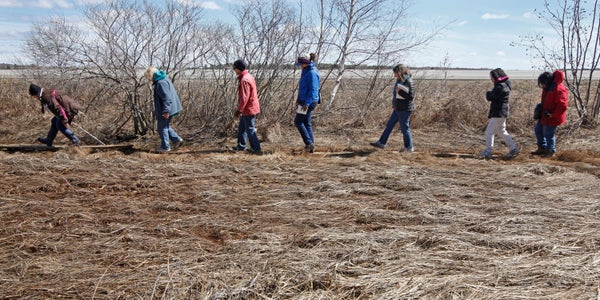

In 2018 biologist Jann Vendetti published a paper that described the discovery of five species of non-native snails and slugs in Southern California. The research would not have been possible without some 1,200 volunteers who uploaded nearly 10,000 photos of gastropods to the SLIME project—that’s Snails and Slugs Living in Metropolitan Environments—on an app called iNaturalist.
“The entire existence of that paper is dependent upon these citizen scientists. How do you credit those people?”
Greg Pauly, herpetology curator at the Natural History Museum of Los Angeles.
On supporting science journalism
If you're enjoying this article, consider supporting our award-winning journalism by subscribing. By purchasing a subscription you are helping to ensure the future of impactful stories about the discoveries and ideas shaping our world today.
“There are some very specific requirements that a lot of journals and a lot of academic societies use. And those requirements largely would exclude nonprofessional scientists. And to me, that’s absurd.”
That’s why Pauly, together with Vendetti, and several Australian biologists are arguing that criteria must change to recognize citizen scientists as authors on scientific journal articles. They propose what they’re calling “group co-authorship.” They make the case in the journal Trends in Ecology & Evolution. [Georgia Ward-Fear et al., Authorship protocols must change to credit citizen scientists]
The author list on Vendetti’s snail-and-slug paper includes the phrase “citizen science participants in SLIME.” But the phrase is absent when you look up the paper on Google Scholar. The publication software simply isn’t equipped to handle that kind of authorship, and so it erases the group’s vital contribution.
In another case, several years ago in Australia, a team of researchers tried to condition native monitor lizards to avoid chowing down on the invasive—and poisonous—cane toads. And for the most, part it worked.
“But the only reason it was successful was because they partnered with the traditional landowners in northwestern Australia, this group called the Balanggarra Rangers.”
Several journals flat-out refused to allow for the inclusion of the Rangers as group co-authors. Eventually, the researchers did convince the editors of some journals to allow it, but the group’s title was abbreviated, as if it was a first and last name, in online indexing software: “B. Rangers.” The researchers argue that these errors and omissions don’t only render the critical contributions of an indigenous community invisible—they could also be perceived as discriminatory.
“If the person who had made that contribution was an undergraduate or a graduate student who was trying to pursue a career in the sciences, we would all say, ‘Of course that person should be a co-author’ or ‘that group of people should be a co-author.’ But we don’t necessarily extend that same line of reasoning to citizen scientists.”
Allowing for group co-authorship is not a new idea. In 2004 the journal Nature published a paper titled “Initial Sequencing and Analysis of the Human Genome.” It listed as the sole author the International Human Genome Sequencing Consortium.”
“Let’s just co-opt this group-authorship model and turn it into group co-authorships. This really shouldn’t be that hard.”
—Jason G. Goldman
[The above text is a transcript of this podcast.]
