
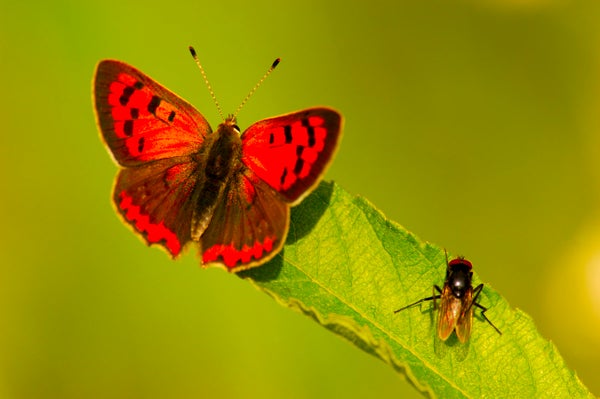

Most critters seem better able to survive big cities if they’re smaller than usual. But a few others are better adapted to urban areas if they’re larger. That's the result of a study of more than 700 types of invertebrates from across 10 different taxonomic groups living in a variety of habitats in northern Belgium.
European ecologists were interested in understanding how animals adapt to urbanization. So they set up a variety of traps in both urban and rural areas, and assessed the body size of more than 95,000 individual critters.
They measured butterflies, beetles, weevils, ground spiders, web-building spiders, moths and grasshoppers. They also tested a handful of more obscure invertebrates, like a group of microscopic shrimplike critters called ostracods, and a group of aquatic crustaceans known as water fleas.
On supporting science journalism
If you're enjoying this article, consider supporting our award-winning journalism by subscribing. By purchasing a subscription you are helping to ensure the future of impactful stories about the discoveries and ideas shaping our world today.
On average, urban communities contained smaller individuals than rural ones. It's not that cities are causing animals to evolve smaller bodies, at least not necessarily. What this study found is that animals that are already smaller seem better suited to city living. The researchers think that has to do with what’s called the urban heat island effect. Animals expend more energy going about their daily lives in warmer areas, and cities tend to be warmer than more natural areas. Smaller body sizes can compensate for that heat effect.
But some groups of city dwellers were actually bigger than were their countryside counterparts.
"For three of our groups, for butterflies, moths, and for grasshoppers, we actually saw a completely reversed pattern…these three groups, out of the 10 groups that we tested, these were the only groups where large species are also the most mobile ones."
Catholic University of Louvain ecologist Thomas Merckx.
These are animals that need wide spaces, something that's in short supply in cities, where roads and housing developments easily fragment natural habitats. Being bigger helps them move from one habitat patch to another more easily than their diminutive relatives. The results are in the journal Nature. [Thomas Merckx, et al., Body-size shifts in aquatic and terrestrial urban communities]
“As humans, we have become urban animals. So this is our new habitat. It wasn't the case a hundred years ago. Only a tiny minority of the human population was living in cities. But urbanization really is taking off. So now more than half of humans are already living in cities, and this is only going to increase."
And humans are part of a wildlife community, even in cities. We need lots of other animals, including ones we might not always think about, like moths and spiders, to thrive in cities as well. Understanding how animals are adapting—or not—to urban areas today can help us build better, more wildlife-friendly cities in the future.
—Jason G. Goldman
[The above text is a transcript of this podcast.]

