
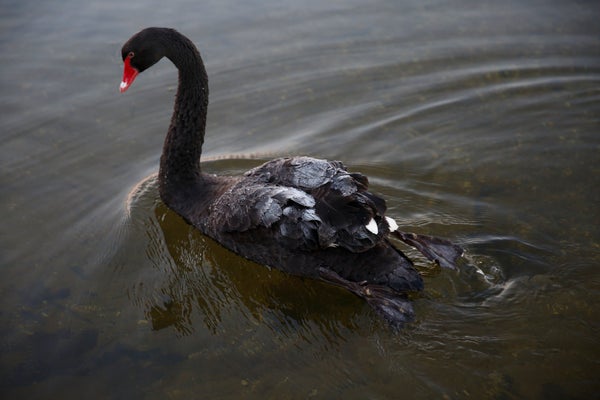

Animals that live in the city are usually less wary of humans than their rural counterparts. Most people think the boldness comes from experience: since the majority of humans are rather harmless, the critters learn to go about their business without fear. But the truth turns out to be far more interesting, at least for Australian swans. Turns out the city birds are genetically different from their country counterparts.
Australian researchers looked at two groups of swans. One population lived on a pond in the center of Melbourne. The second hung out just 30 kilometers away in a more bucolic setting, surrounded by far fewer humans. The researchers measured what they call each bird’s “flight initiation distance”: basically, how close could a human get before the swan would fly away?
“We found that the flight initiation distance for the swans at the urban environment was only 13 meters, and on average at the non-urban environment it was 96 meters. So that’s like an 83 meter difference, a really big difference in how wary these swans are at the two habitats.” Victoria University ecologist Wouter van Dongen.
On supporting science journalism
If you're enjoying this article, consider supporting our award-winning journalism by subscribing. By purchasing a subscription you are helping to ensure the future of impactful stories about the discoveries and ideas shaping our world today.
The researchers also took blood samples from some of the swans to analyze their DNA. And almost 90 percent of urban swans had the same variant of a gene for dopamine transport, while just 60 percent of rural birds had that version. And those swans were less wary of humans than were the swans with the rarer genotypes.
Dopamine influences a lot of brain function, so the gene variation could be behind the difference in swan attitudes. The study is in the journal BMC Evolutionary Biology. [Wouter F. D. van Dongen et al, Variation at the DRD4 locus is associated with wariness and local site selection in urban black swans]
Since swans can easily fly wherever they want, the researchers think that the bolder birds don’t mind setting up shop in the city, while the more timid swans prefer the quieter country life. And that’s something that wildlife managers should keep in mind.
"With release programs, often you breed up a small population of whatever animal and then you release them into the wild…and so one potential application of our research is to select individuals that are better able to cope with human disturbance, those that are less wary of humans, and release them into those areas that are more likely to experience human disturbance."
—Jason Goldman
[The above text is a transcript of this podcast.]
