
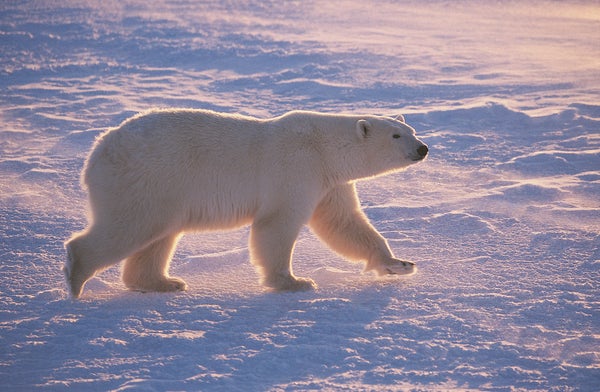

Polar Bears spend most of their time roaming the sea ice in search of seals. And seals spend most of their time underneath that ice, avoiding the top predator. But climate change is giving polar bears additional challenges in their searches for food.
“Sea ice is now drifting faster.” George Durner is a research zoologist with the United States Geological Survey Polar Bear Research Program. He and colleagues compared sea ice conditions from 1987–1998 with those from 1999 to 2013.
“And what we found was ice drift at the locations used by polar bears increased 30% in the Beaufort sea and 37% in the Chukchi sea.” That’s a problem because polar bears are homebodies—they prefer to stay in a specific range.
On supporting science journalism
If you're enjoying this article, consider supporting our award-winning journalism by subscribing. By purchasing a subscription you are helping to ensure the future of impactful stories about the discoveries and ideas shaping our world today.
“Throughout their range, they seem to have a sense of place. And…here we have a situation where the general pattern of ice drift is westward, so to remain in your traditional range, it means you have to constantly be walking eastward to compensate for that westward drift.”
The result: a large-scale polar bear treadmill. And all that walking requires extra fuel. On average, a single bear eats between 31 and 33 seals per year. But the metabolic consequence of the treadmill effect means they have to eat on average one to three more. The study is in the journal Global Change Biology. [George M. Durner et al., Increased Arctic sea ice drift alters adult female polar bear movements and energetics]
And not only is the ice drifting faster—it’s also melting more, giving the bears less of the platform they use to pursue their prey. So they need more seals but have a tougher time tracking them. All of which puts polar bears on a slippery slope.
—Emily Schwing
[The above text is a transcript of this podcast.]
