
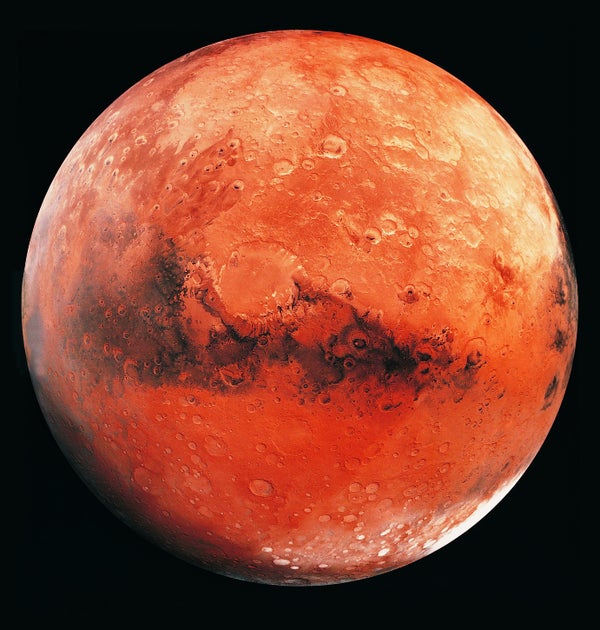

The surface of Mars is etched with ancient river valleys and lake basins. Which makes researchers think that liquid water once flowed on the Red Planet. But how? Today, Mars is too cold for much, if any, liquid water to exist. And 3.8 billion years ago, when the flowing water features formed, the sun was fainter than it is today, making it even harder to imagine a balmy Martian climate. That’s why many researchers think Mars may have gone in and out of deep freezes.
“The real questions have been: for how long was it warm, and what was the mechanism for warming it up.”
James Kasting, a geologist at Penn State University. He shared his take on the problem at the December meeting of the American Geophysical Union in San Francisco, and in the journal Earth and Planetary Science Letters. [Natasha E. Batalha et al., Climate cycling on early Mars caused by the carbonate–silicate cycle]
On supporting science journalism
If you're enjoying this article, consider supporting our award-winning journalism by subscribing. By purchasing a subscription you are helping to ensure the future of impactful stories about the discoveries and ideas shaping our world today.
Some researchers have suggested that early Mars only thawed out when large asteroid impacts or volcanic eruptions temporarily warmed the planet. But Kasting and others think warm windows from such dramatic events would have been too brief to carve the vast canyons that exist on Mars. Now, Kasting and his colleagues have come up with an alternative explanation: they think Mars may have experienced a series of climate cycles caused by changes in the strength of the greenhouse effect.
The idea goes like this: when Mars was cold and frozen, volcanoes continued to belch out the greenhouse gases carbon dioxide and hydrogen into the atmosphere. There, the gas blanket trapped heat and warmed the planet up until liquid water began to flow, forming Mars’ rivers and lakes. However, warm temperatures and abundant water would also have sped up certain chemical reactions that consumed carbon dioxide, reducing the greenhouse effect and cooling the planet back down again. Then the cycle would repeat.
“Which is similar to what the impact people have been arguing, except that when it gets warm, it can stay warm for millions of years instead of thousands of years.”
So far, Kasting’s team has only shown that such an explanation is possible, according to climate models. But the researchers say NASA’s Curiosity rover and other future Mars missions could help test the idea by looking for evidence of multiple warm events, and their durations. Perhaps, hidden in the dry Martian dust lie clues to a surprisingly soggy past.
—Julia Rosen
[The above text is a transcript of this podcast.]
