
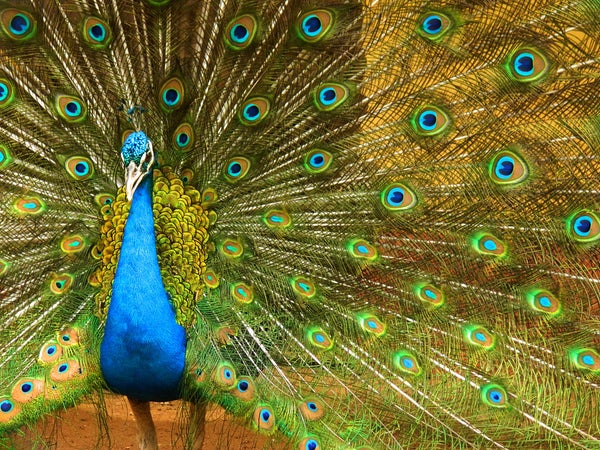

One of the most impressive scenes in the world of birds is a peacock displaying its impressive, iridescent feathers, technically known as its train. While the female peahen looks on, the peacock spreads his train out and ruffles it back and forth as the sun highlights the red, blue, and green within the feathers.
But these iconic trains are only half of the story of how the boys impress the ladies. Both male and female peafowl sport crests on their heads, small feathers that stick straight up, like a Mohawk.
On supporting science journalism
If you're enjoying this article, consider supporting our award-winning journalism by subscribing. By purchasing a subscription you are helping to ensure the future of impactful stories about the discoveries and ideas shaping our world today.
"The crest feathers that actually give the peacocks' their Latin name, they're called Pavo cristatus, the crested pheasant. And so I was intrigued by the fact that people didn't really know what the function of these crests were."
Haverford College physicist Suzanne Kane.
A biologist might see those feathers and assume they are visual signals, but as a physicist, Kane had a different idea.
"We were curious in my laboratory about whether the preferred vibrational properties of the crest feathers might, by any chance, agree with the preferred vibrational properties of this train-rattling display that the males do.
So the Kane and her colleagues exposed crest feathers from preserved, dead peafowls to simulated displays of male and female social behaviors, like wing-shaking and train-rattling.
"And so we were just gobsmacked to find out that they did agree."
What all that means is that the peafowls' head crests are specifically tuned to the vibrations produced by the train-rattling of its own species. The crests thus act like a sort of special antenna meant to pick up a single kind of sound. The findings are in the journal PLOS ONE. [Suzanne Amador Kane et al., Biomechanics of the peafowl's crest reveals frequencies tuned to social displays]
The researchers also point out that there are at least 35 other types of birds, distributed across ten taxonomic orders, that have both head crests and displays with a vibration component.
"A lot of those tactile aspects of displays are really not even very well described."
University of British Colombia zoologist Roz Dakin, who worked with Kane on this study.
"There are species that dance and vibrate on perches, and the female's sharing the same perch as the male, and feeling what's going on through parts of her body like her feet. There are species where birds rub feathers on each other… What we're suggesting here is that a sensory function of feathers in social displays may be more widespread than we appreciate right now."
Seems that the females really do feel something about a particular peacock.
—Jason G. Goldman
[The above text is a transcript of this podcast.]

