
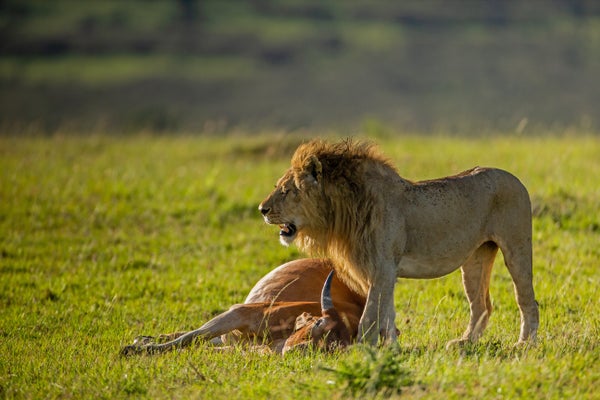

In Botswana, farmers graze their cattle at the edge of the Okavango Delta. The region is teeming with wildlife, including hungry predators with a taste for beef.
“Lions and leopards, in particular, are ambush predators. They often rely on the element of surprise to creep up and take down their prey.”
University of New South Wales conservation biologist Neil Jordan.
On supporting science journalism
If you're enjoying this article, consider supporting our award-winning journalism by subscribing. By purchasing a subscription you are helping to ensure the future of impactful stories about the discoveries and ideas shaping our world today.
“Livestock losses can be crippling to some of these farmers, and their subsequent retaliatory killing of predators in response to that is a major cause of population decline in large carnivores.”
But what if there were a simple thing farmers could do to cut their losses?
“The idea came about of painting eyes on the backsides of cows to trick lions and leopards into thinking they’ve been seen by their would-be prey. And once seen, they often abandon the hunt.”
This visionary solution was inspired by nature. A variety of species have evolved eyespot markings that thwart deadly adversaries—some frog derrieres feature eyespots, as do the backends of some fish. Jordan’s colleague, Cameron Radford:
“Probably the most famous example is on butterflies and moths. They have eyespots in their wings, and these deter predators such as birds from attacking them.”
Even humans are susceptible to eyespots: one study found that people are less likely to steal bikes when an image of watchful eyes is displayed near bike racks. But despite their usefulness, predator-foiling eyespots don’t occur naturally in mammals. To make up for this egregious evolutionary oversight, the scientists/cow-butt artists got to work.
“I can guarantee the cows didn’t enjoy the experience. I mean it, didn’t hurt them at all, but herding those cows up in the morning for their artificial-eye treatment probably wasn’t the most exciting thing for them.”
Over the four-year experiment, the researchers found that not one of the hundreds of cows with eyespots on their keisters was killed by an ambush predator. But the study also showed that, while less effective, simply painting crude cross marks on the cows deterred predators better than leaving them au naturel. So perhaps any kind of novel marking can startle an unsuspecting carnivore.
“Farmers can potentially paint their cattle with artificial eyespots or cross marks. But we recommend the eyespots because that was the best result.”
The Botswana Predator Conservation Trust and the Taronga Conservation Society Australia also contributed to this research, which appeared in the journal Communications Biology. [Cameron Radford et al., Artificial eyespots on cattle reduce predation by large carnivores]
Ultimately, a little artistic license could go a long way to safeguard both livestock herds and predators at risk of extinction.
—Susanne Bard
[The above text is a transcript of this podcast.]
