
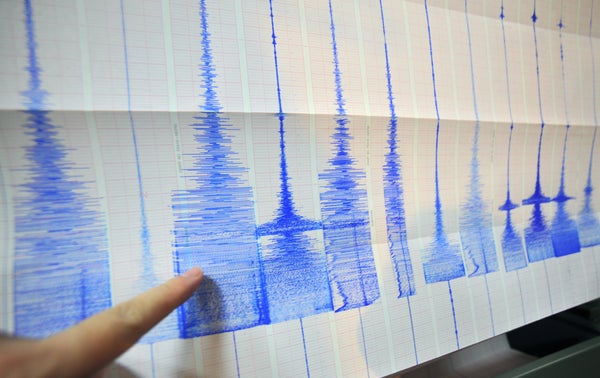

When an earthquake hits or a volcano erupts, scientists traditionally record the shaking using a specially designed instrument called a seismometer. These sensors are extremely sensitive, but they’re also expensive and distributed unevenly around the world. So scientists are working on another strategy to monitor earthquakes: using fiber-optic cables—like the ones that form the backbone of the internet.
“So the motions are very clear. Specifically, you can see the arrival of different bits of the seismic energy from the location at which the earthquake occurred. So the p wave and the s wave, and the different phases that move out from the site of rupture in the earth, are used by seismologists to locate the event. And so we can detect the important pieces of information above the noise using the fiber-optic cable and then, in that way, the fiber-optic measurement is just as good as a seismometer.”
Nate Lindsey, a PhD student and seismologist at the University of California, Berkeley. Here’s how it works: the scientists basically take a snapshot of the fiber by shining a laser down it and measuring the photons that bounce back after scattering off of small cracks and impurities in the glass. By doing this tens of thousands of times a second, the researchers can record how the cable deforms as seismic waves pass through it.
On supporting science journalism
If you're enjoying this article, consider supporting our award-winning journalism by subscribing. By purchasing a subscription you are helping to ensure the future of impactful stories about the discoveries and ideas shaping our world today.
So far, Lindsey’s team has tested the technique in optical fibers they installed themselves in Fairbanks, Alaska, and around the Bay Area. They got promising results. But their ultimate goal is to capitalize on the vast network of unused cables—known as dark fiber—that’s already been installed by telecommunications providers for future use. Dark fiber covers much of the country, and stretches across the ocean basins—which are hard to study using traditional seismometers.
“To put the same sensor near a volcano that occurs offshore requires infrastructure to deploy the sensor, like a big boat. It also requires a tethered cable, a battery. The sensor has to be waterproof, obviously. It’s also very corrosive underneath the ocean, and so there’s been a limitation of our ability to study offshore volcanoes. Similarly faults. Earthquake processes are understood based on faults that are on land.”
Offshore cables could also improve earthquake early warning systems in places like the Pacific Northwest, where big, dangerous earthquakes actually occur under the ocean.
“We can record that earthquake more quickly and then provide a warning that much quicker. So it might be a second or two seconds more that this fiber-optic technology provides.”
Lindsey is presenting his work this week at the fall meeting of the American Geophysical Union in New Orleans. The results were also published recently in Geophysical Research Letters. If the technique proves reliable, Lindsey says it could usher in a whole new way of studying earthquakes and volcanoes. All that dark fiber may shed light on the Earth beneath our feet.
—Julia Rosen
[The above text is a transcript of this podcast.]
