

It seems the first resident of Earth to break the sound barrier wasn't Chuck Yeager, after all. He was about a hundred million years too late.
Apatosaurus was a cousin of Brontosaurus, but even bigger—with a 40-foot-tail more than three feet thick at the butt end but no wider than your pinky at the tip. That dainty end made the tail too fragile for clubbing attackers. So what was it for? Maybe this: [bullwhip crack]
The idea that Apatosaurus might have used its tail like a bullwhip—to scare off predators, communicate or even show off for potential mates—gained traction about 20 years ago. That’s when paleontologist Philip Currie of the University of Alberta teamed with Nathan Myhrvold to create a computer simulation that showed the whip-cracking tail was plausible. Myhrvold is the founder and CEO of Intellectual Ventures—an invention firm in the Seattle suburbs—where I’m executive editor.
On supporting science journalism
If you're enjoying this article, consider supporting our award-winning journalism by subscribing. By purchasing a subscription you are helping to ensure the future of impactful stories about the discoveries and ideas shaping our world today.
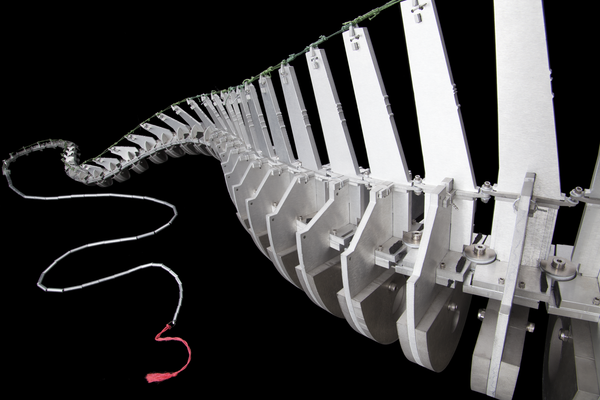
This week at a meeting of the Society for Vertebrate Paleontology, Myhrvold, Currie and Dhileep Sivam, also of Intellectual Ventures, unveiled a quarter-scale physical model of an Apatosaurus tail made from aluminum vertebrae and steel tendons. [Supersonic Sauropods: The Physical Model (p. 214)]
Give the big end of the model a strong push and pull, and it does this: [audio of model crack]. Our analysis of high-speed video of the tail in action found that the tip moves at more than 800 miles an hour—fast enough to break the sound barrier and create a small sonic boom.
A full-size apatosaur whipping its tail in this way could probably have produced a sound loud enough to shatter human eardrums. Which must have really gotten their attention back in the late Jurassic.
—Wayt Gibbs
[The above text is a transcript of this podcast.]
