
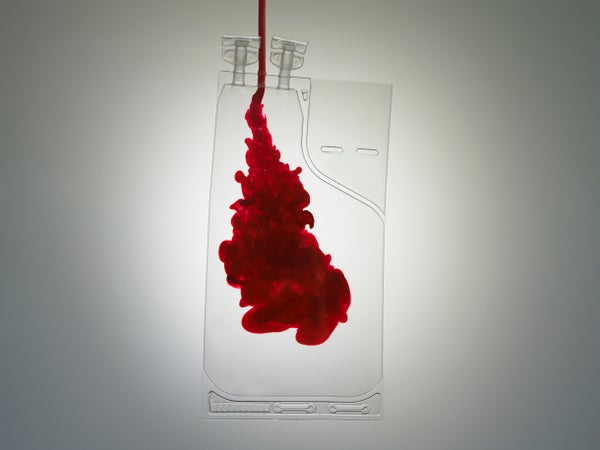

Blood donations save lives. But blood can only be stored under refrigeration for up to six weeks. After that, it’s no longer usable for transfusions.
“Because of that limitation, people have to continually donate blood to meet the needs. But also, in places where refrigeration may not be available, that can also be a challenge. It’s difficult to have blood available when needed.”
University of Louisville bioengineer Jonathan Kopechek. He says disruptions to regular blood donations due to COVID-19 have put stress on the blood supply, and the pandemic underscores the need for more reliable long-term storage methods. Blood can be frozen for extended periods of time ...
On supporting science journalism
If you're enjoying this article, consider supporting our award-winning journalism by subscribing. By purchasing a subscription you are helping to ensure the future of impactful stories about the discoveries and ideas shaping our world today.
“But it’s pretty rare because of all the challenges and complexities with that process.”
Instead Kopechek’s team has developed a method of preserving blood so it can be stored in a dehydrated state at room temperature. To do so, they turned to an unusual preservative: a sugar called trehalose, which is a common ingredient in donuts ...
“To help make them look fresh even when they might be months old, and you wouldn’t know the difference.”
The researchers chose trehalose because, in nature, it’s made by hardy animals like tardigrades and sea monkeys—aka brine shrimp—famous for their ability to survive dehydration.
“So these animals can dry out completely for a long period of time and then be rehydrated and resume normal function. So we wanted to use the trehalose that’s produced by these organisms and apply that to preserving blood cells in a dried state, just like those organisms are.”
But first, the researchers had to get trehalose into blood cells. They used ultrasound to drill temporary holes in the cell membranes—which let some trehalose get in.
“And they need to have sufficient levels of trehalose on both the inside and the outside of the cell in order to survive the dehydration and rehydration process.”
At that point, the blood could be dried and made into a powder.
“And then we can rehydrate the blood and have it return back to normal.”
The team is still trying to improve yields but thinks the dried blood could be stored at room temperature for years. The study is in the journal Biomicrofluidics. [Connor S. Centner et al., Ultrasound-induced molecular delivery to erythrocytes using a microfluidic system]
Kopechek says the technique could be ready for clinical trials in three to five years. If successful, it could be used to create stores of dried blood in case of future pandemics or natural disasters—and for humanitarian aid work, military operations or even missions to Mars. Maybe first aid kits on the Red Planet will include dried red blood cells.
—Susanne Bard
[The above text is a transcript of this podcast.]
