
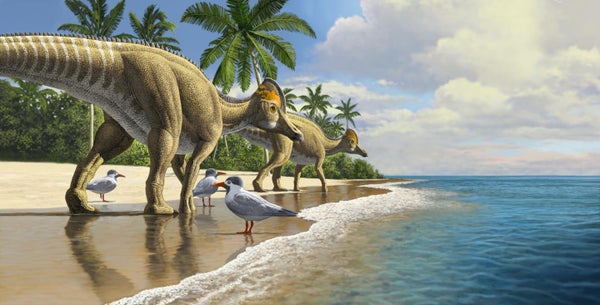

In North America, fossils of duckbill dinosaur are abundant. So abundant that paleontologists sometimes ignore them in search of more exciting species, like T. Rex or Triceratops.
“They were so common we often wouldn't collect them and just left them out in the field.”
University of Bath evolutionary biologist Nick Longrich.
On supporting science journalism
If you're enjoying this article, consider supporting our award-winning journalism by subscribing. By purchasing a subscription you are helping to ensure the future of impactful stories about the discoveries and ideas shaping our world today.
But duckbills had never been found in Africa. So, Longrich did a double take when he was visiting the Natural History Museum of Marrakesh in Morocco and came across the 66-million-year-old jawbone of a previously undocumented duckbill species.
“I instantly knew what it was, and I just couldn't figure out what it was doing there.”
Its presence in North Africa was problematic because during the Late Cretaceous period the planet was warmer, which means sea levels were higher.
“Africa was isolated from all the other continents by water, and there didn't seem to be any way that they could get there.” Unless, perhaps, duckbills swam hundreds of miles across open ocean from what is now Europe.
It's not as far-fetched as it might sound. In fact, paleontologists once thought duckbill dinosaurs were aquatic, but that theory eventually fell out of favor. Nonetheless, there's evidence that duckbills were well-adapted for swimming.
“They have these really big, powerful hind limbs. Great big feet. They've got a long, deep tail they could have used for sculling. So, they might have been pretty good swimmers.”
Plus, other animal species have been known to cross oceans, albeit rarely. Elephants, monkeys, and even hippos, for example, have all colonized new places after swimming or floating there.
“It's incredibly improbable. But over millions of years, these once-in-a-million-year events will happen on average once every million years.”
To better understand the migrations of duckbill dinosaurs, Longrich and his colleagues reconstructed their evolutionary tree.
“The duckbills seem to originate in North America. They migrate across the land bridge into Asia, jump over into Europe. And then finally this European lineage, one branch of that evolutionary tree, jumps into Africa.”
Longrich's team dubbed the new species Ajnabia odysseus. Some duckbills were 50-feet long, but Ajnabia was perhaps the smallest of these Cretaceous vegetarians, about the size of a pony. And while North American duckbills were being hunted down by hungry T. rex, in Africa, Ajnabia likely had to contend with fearsome Abelisaurs, which were smaller, but similar to T. rex.
The study is in the journal Cretaceous Research. [Nicholas R. Longrich, et al., The first duckbill dinosaur (Hadrosauridae: Lambeosaurinae) from Africa and the role of oceanic dispersal in dinosaur biogeography]
Insights into Ajnabia could help answer questions about the end of the age of the dinosaurs.
“This is just before the asteroid hit. So, we're getting a snapshot of the dinosaurs in their final moments. The sort of twilight of the dinosaurs. Along with things like T-Rex and Triceratops, these were the last dinosaurs on earth.”
—Susanne Bard
(The above text is a transcript of this podcast)
