Election 2020: The Stakes for Science

Scientific American’s editor in chief sets up this week’s series of podcasts about how this election could affect science, technology and medicine.

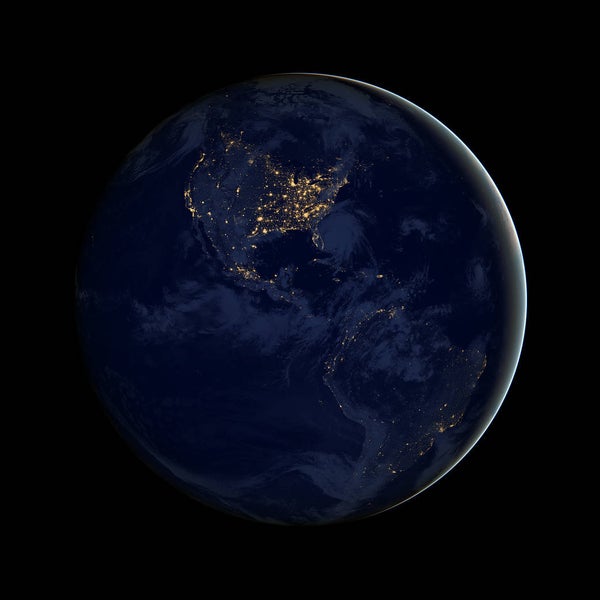
Image of the Americas at night is a composite assembled from data acquired by the Suomi National Polar-Orbiting Partnership satellite in April and October 2012.

Illustration of a Bohr atom model spinning around the words Science Quickly with various science and medicine related icons around the text

Join Our Community of Science Lovers!

Election Day is November 3rd. In this week before the election, we’re rolling out a special series of short podcasts in which we’ll look at how the election could affect some major areas of science. To set up what you’ll hear the rest of the week, I spoke to Scientific American’s editor in chief Laura Helmuth.

“There’s a lot to talk about. The election is almost upon us; people are voting already. And some of the biggest issues that will be decided by this election have to do with science and health and the environment and our future energy structure and climate change. And it’s an urgent time to talk about these subjects.”

And we’re not endorsing your candidate in this case. We are just laying out the terms of what the stakes are for these scientific areas in this election.


On supporting science journalism

If you're enjoying this article, consider supporting our award-winning journalism by subscribing. By purchasing a subscription you are helping to ensure the future of impactful stories about the discoveries and ideas shaping our world today.


“Absolutely. I mean, there are a lot of reasons to vote for one candidate or, for some people, the other. But really, if you’re interested in scientific subjects, there will be a lot of different directions the country will go in—one direction or the other—depending on this election. And we just want to lay out what the stakes are.”

And what do we say to the inevitable audience member who just doesn’t want to hear about politics when they come to a science venue?

“That is a good question. And I think all of us right now, especially when there’s so much politics in the air, it’s really refreshing to come somewhere and to think about black holes or the age of the universe or how dinosaurs evolved. And we will continue to be talking about those things. If politics settles down, we’ll be doing probably more of those than we have in the past few years. But at this moment, the future of the research enterprise is really on the line. And we just think it’s important for people to know how dramatically one administration or another can influence the way that scientific collaboration happens, the way science is communicated, what the priorities are for what should be studied and how.”

—Steve Mirsky

[The above text is a transcript of this podcast.]

Laura Helmuth was formerly editor in chief of Scientific American. She previously worked as an editor for the Washington Post, National Geographic, Slate, Smithsonian and Science. She is a former president of the National Association of Science Writers. She is currently a member of the National Academies of Sciences, Engineering, and Medicine's standing committee on advancing science communication and an advisory board member for SciLine and The Transmitter. She has a Ph.D. in cognitive neuroscience from the University of California, Berkeley. She recently won a Friend of Darwin Award from the National Center for Science Education. Follow her on Bluesky @laurahelmuth.bsky.social

More by Laura Helmuth

Steve Mirsky was the winner of a Twist contest in 1962, for which he received three crayons and three pieces of construction paper. It remains his most prestigious award.

More by Steve Mirsky

It’s Time to Stand Up for Science

If you enjoyed this article, I’d like to ask for your support. Scientific American has served as an advocate for science and industry for 180 years, and right now may be the most critical moment in that two-century history.

I’ve been a Scientific American subscriber since I was 12 years old, and it helped shape the way I look at the world. SciAm always educates and delights me, and inspires a sense of awe for our vast, beautiful universe. I hope it does that for you, too.

If you subscribe to Scientific American, you help ensure that our coverage is centered on meaningful research and discovery; that we have the resources to report on the decisions that threaten labs across the U.S.; and that we support both budding and working scientists at a time when the value of science itself too often goes unrecognized.

In return, you get essential news, captivating podcasts, brilliant infographics, can't-miss newsletters, must-watch videos, challenging games, and the science world's best writing and reporting. You can even gift someone a subscription.

There has never been a more important time for us to stand up and show why science matters. I hope you’ll support us in that mission.

Thank you,

David M. Ewalt, Editor in Chief, Scientific American

Subscribe