

In the 1800s, renowned explorer and naturalist Alexander von Humboldt observed a bizarre incident in the Amazon: he saw electric eels leaping into the air and shocking two horses. But some who heard the story thought Humboldt was a humbug: “Humboldt had described eels attacking horses…but people didn’t necessarily believe it.” Kenneth Catania, a professor of biological sciences at Vanderbilt University.
But Humbolt was vindicated last year, when Catania published a study showing that electric eels indeed jump in the air to jolt potential predators. This maneuver is the most efficient way for an eel to deliver its shock. When the animal is submerged, electricity is lost to the water. By going airborne “the eel is essentially using that principle of physics to divert more and more current into the target.”
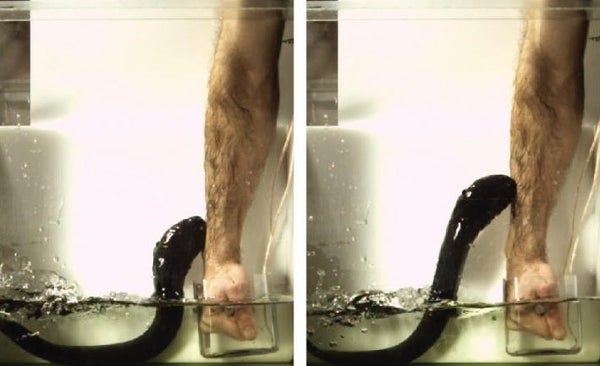
But Catania still wanted to know more—like, exactly how strong is an eel’s shock to a human? To figure out the forces behind this electrifying leap, Catania used a relatively small eel and a human subject—himself.
On supporting science journalism
If you're enjoying this article, consider supporting our award-winning journalism by subscribing. By purchasing a subscription you are helping to ensure the future of impactful stories about the discoveries and ideas shaping our world today.
“I approached the eel with my hand in a container, which has a metal strip on it. And the eel decided it was concerned about whatever apparent creature might be coming near it…it came out of the water as I planned, up over the metal piece and onto my arm…that allowed me to measure the current flowing through my hand.”
After taking various measurements and getting electrocuted 10 times by the eel, Catania discovered that even a small eel can deliver as much as 40 to 50 milliamps of electrical current. That’s more than enough to activate the pain receptors and withdrawal reflexes of horses, dogs and humans.
“So I worked around horses when I was younger, and I backed into an electric fence a couple times. It’s a good analogy for what the eel is doing…and the animals learn not to touch the fence, and the eel teaches you not to touch the eel.”
Catania’s new research is in the journal Current Biology. No pun intended. [Kenneth C. Catania, Power Transfer to a Human during an Electric Eel’s Shocking Leap]
“It’s a really interesting behavior to be able to quantify, basically, what’s going on when the eel does this, because it’s a unique defense in the animal kingdom.” Plus, “This would basically give you a starting point to figure out what would go on with large electric eels in the Amazon.” Which, as Humboldt showed, are not horsing around.
—Annie Sneed
[The above text is a transcript of this podcast.]
