
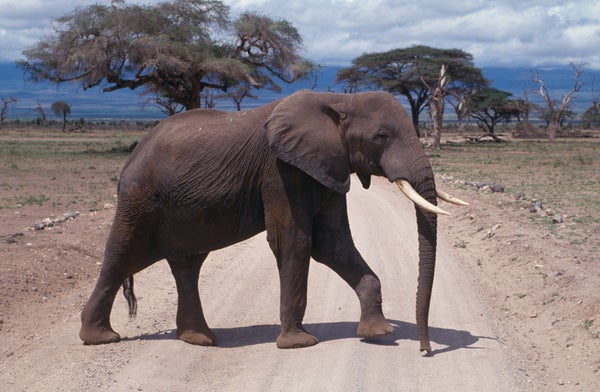

Imagine a world without elephants. Not only would we have lost one of the planet’s most charismatic, extraordinary creatures. Also gone would be a network of ecosystem engineers—because elephants are crucial for other creatures to exist.
They disperse seeds in their copious droppings. By literally cutting paths through forests as they trample trees and bushes, they create a more complex landscape. And now we know that their very footprints are important.
"We were walking through the forest in Kibale National Park…and that's when we stumbled upon these water-filled elephant footprints.”
On supporting science journalism
If you're enjoying this article, consider supporting our award-winning journalism by subscribing. By purchasing a subscription you are helping to ensure the future of impactful stories about the discoveries and ideas shaping our world today.
University of Koblenz–Landau ecologist Wolfram Remmers.
“And we looked at them and we quickly noticed that they were not only filled by water, but there were lots of animals living in them."
Remmers and his colleagues discovered that elephant footprints are a critical habitat for aquatic invertebrates like water beetles. The team studied 30 footprints in different parts of the national park in Uganda to see just who calls this unique habitat their home. In all, they found 61 species from 27 taxonomic orders.
The researchers then created 18 artificial footprints to see how fast they would be colonized. Water beetles showed up on day one. After five days, 410 individual invertebrates were occupying the prints. The findings are in the African Journal of Ecology. [Wolfram Remmers et al., Elephant (Loxodonta africana) footprints as habitat for aquatic macroinvertebrate communities in Kibale National Park, south-west Uganda.]
"If you think of these footprints as tiny islands in a big forest, it was amazing to me to see how quickly these small animals could find them and colonize them and use them as habitat for foraging and reproduction and living."
In some places, elephant footprints are the only stagnant ponds to be found, which could mean that these insects depend on the pachyderms for their very survival. But because this discovery is so new, nobody really knows how critical these habitats are.
"We are not sure how much they are really dependent on elephant-made footprints in other areas, or if they would completely disappear or if they would just be there in a lower number."
Without additional protections, elephants will undoubtedly disappear from large swaths of their ranges. Which means a huge community of invertebrates might be severely restricted in their ability to move across the landscape—with ecosystem consequences we can only guess at.
—Jason G. Goldman
[The above text is a transcript of this podcast.]
