
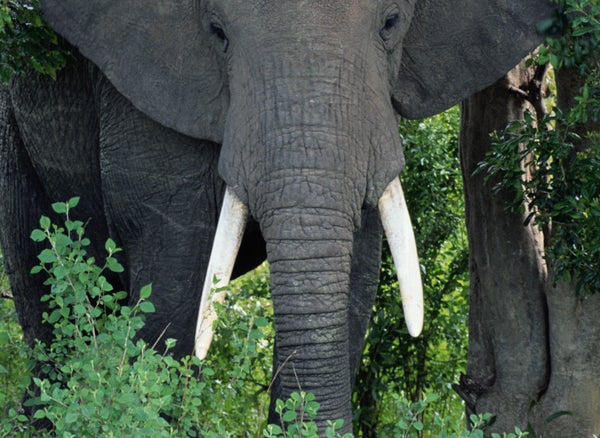

“There are about 50,000 elephants a year being killed right now with only about 450,000 left in Africa.”
Samuel Wasser, director of the Center for Conservation Biology at the University of Washington.
“And one of the complexities of this problem is dealing with this transnational organized crime, where you have these sophisticated networks of criminal entities that are experts at moving contraband from one place to another without it being detected.”
On supporting science journalism
If you're enjoying this article, consider supporting our award-winning journalism by subscribing. By purchasing a subscription you are helping to ensure the future of impactful stories about the discoveries and ideas shaping our world today.
Wasser spoke February 14th at the annual meeting of the American Association for the Advancement of Science in Washington, D.C.
“What we have done is we’ve tried to focus our attention using genetics to determine the source of the actual poaching and to figure out how many major source populations are there. Because in doing that you can potentially focus law enforcement on those areas…
“Now the way that we focus on this work is we use DNA from large ivory seizures…worth a minimum of a million dollars…and that is the seizures that bear the signature of large organized crime syndicates…
“The work we published in Science last July showed that virtually 100 percent of all large ivory seizures that we analyzed in the last decade came from really just two locations. Twenty-two percent of the ivory was made up of forest elephant ivory, and that came from an area we call the Tridem, which is the northeast corner of Gabon and northwest corner of Congo. And 78 percent of the ivory was savannah ivory, and that all came from Tanzania and the areas just bordering Tanzania. So Tanzania clearly is the biggest hotspot that we have encountered in this trade…
[S.K. Wasser et al, Genetic assignment of large seizures of elephant ivory reveals Africa’s major poaching hotspots]
“One of the things that this suggests is that the number of kingpins driving this trade are relatively few because so much of this big trade is focused in one area...
“Our work has already brought down one of the largest ivory dealers in West Africa. We are now hot on the trail of probably the largest ivory dealer in Africa.”
—Steve Mirsky
[The above text is a transcript of this podcast.]
