

Humans are hardly alone in their need for sleep—as any cat owner knows. But what about other, very different animals?
“In thinking about this…we wanted to use an evolutionary argument to figure out what is the simplest animal to sleep.” Ravi Nath, a graduate student of biology and bioengineering at Caltech.
“We decided to approach it from a conservation point of view, how conserved the sleep state is. And looked back into the animal tree and specifically looked at jellyfish.” Claire Bedbrook, also a biology and bioengineering graduate student at Caltech.
On supporting science journalism
If you're enjoying this article, consider supporting our award-winning journalism by subscribing. By purchasing a subscription you are helping to ensure the future of impactful stories about the discoveries and ideas shaping our world today.
Jellyfish have no central nervous system. “They do have neurons—their nervous system is a sort of loose set of neurons that control the animal’s behavior. There’s no control center.”
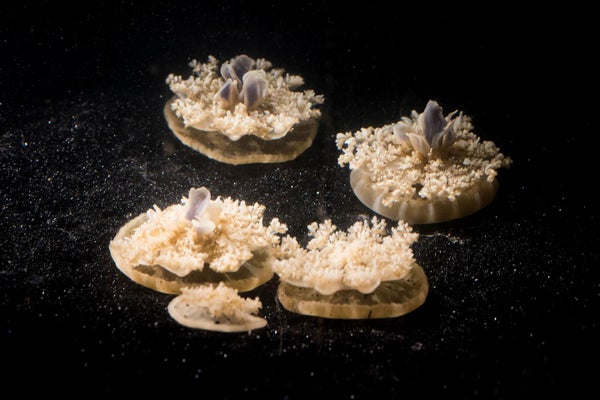
Nath, Bedbrook and the rest of their team worked with a species known as the upside-down jellyfish. “Unlike jellyfish that we’re probably most used to seeing in the wild, these jellyfish actually rest their bell on the seafloor, or in our case the tank bottom, and they pulse in place.” These habits made this jellyfish easy to observe.
The researchers recorded the animals’ behavior during the day and at night, to see if these jellyfish met the scientific criteria for sleep. “Those three behavioral criteria are, first, that the animal goes through a period of quiescence where they are less active. The second is that during this quiescent state, the animals are not as responsive to environmental stimulus. And the third is that this quiescent state is actually necessary for the animal’s well-being and survival.”
The observations revealed that these jellyfish do in fact sleep. That’s a big deal because for scientists “there was this assumption in the community that you needed to have a certain level of complexity”—namely a central nervous system—“to actually sleep. And I think this study really challenges that assumption.” The finding is in the journal Current Biology. [Ravi D. Nath, Claire N. Bedbrook et al., The Jellyfish Cassiopea Exhibits a Sleep-like State]
So what does this study tell us about why animals sleep, and how sleep evolved? Bedbrook says that although more work needs to be done, they have some ideas. “One hypothesis that we really like is that any animal that has neurons will have a sleep state, and that sleep might be an intrinsic property of neurons.” Nath agrees. “So neurons have a huge metabolic cost, and so maybe this period of sleep is a period of consolidated energy conservation that has evolved with neurons essentially.”
So nerves might be keeping you up at night—but having nerves is what’s probably putting you to sleep.
—Annie Sneed
[The above text is a transcript of this podcast.]
