
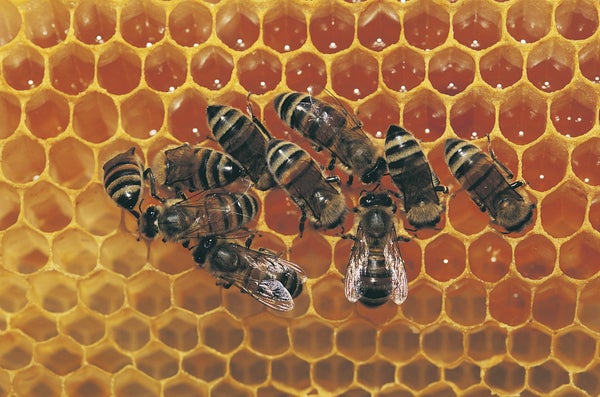

Honeybees. They have a difficult task. First, they have to find food. Then they have to return to the hive to tell their compatriots where to find it. The bees have to fly back and forth between the hive and their food, over and over again. And they need to deal with whatever obstacles lie along their flight paths.
"Honeybees face a lot of challenge in choosing efficient foraging routes through dense environments. And we basically want to study how they choose effective routes…the safest and least energy-expending routes."
Marielle Ong, a researcher at the University of Queensland in Australia. To track the insects’ navigation, she and her team set up tiny obstacle courses for more than a hundred honeybees.
On supporting science journalism
If you're enjoying this article, consider supporting our award-winning journalism by subscribing. By purchasing a subscription you are helping to ensure the future of impactful stories about the discoveries and ideas shaping our world today.
Along the way, the bees were forced to fly through one or the other of two openings of different sizes. And as a group, the bees usually flew through the wider opening, which makes sense. Less chances of slamming their tiny bee bodies into a wall.
But things got more interesting when Ong looked at the decisions made by individual bees, one by one.
“We found that 55 percent had no biases, and the rest of the 45 percent was a split between left-handed bees and right-handed bees."
In other words, some honeybees have a sidedness. They obviously don’t have hands, but let’s say they’re either right-handed or left-handed. So, for example, a right-handed bee would prefer to navigate the cramped right-side opening in the obstacle than go through the left-side hole, even though it was larger and safer. Sometimes, the handed bees would even land and walk through the smaller opening, just so they could use their preferred side.
These biases apparently help the members of large swarms navigate through a complex environment without crashing into each other. If all bees were right handed, it would take a long time for the entire group to pass through a small opening, such as a hive entrance. But by having a range of side biases, the entire swarm can move more quickly when it encounters an obstacle.
The research is in the journal PLOS One. [Marielle Ong et al., Obstacle traversal and route choice in flying honeybees: Evidence for individual handedness]
Ong thinks that one day engineers could apply this finding. They could design robotic drone swarms to negotiate obstacles more efficiently. They could even program self-driving cars to operate less like a chaotic assortment of humans and more like…an orderly group of honeybees.
—Jason G. Goldman
[The above text is a transcript of this podcast.]
