
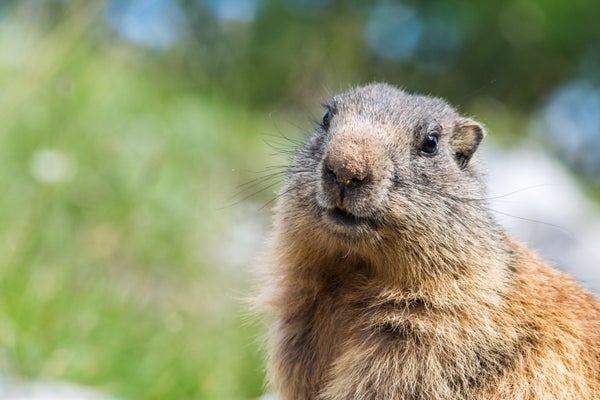

February 2: the day each year when we look toward an oversized rodent to find out how much more winter we’ll endure. In honor of the occasion, here’s seven things you might not have known about the groundhog.
1. The groundhog’s scientific name is Marmota monax, making it one of 14 types of marmot that can be found in the Northern Hemisphere. Marmots are members of the Sciuridae family, which makes the groundhog just a really big ground squirrel.
2. As just noted, groundhogs are a type of marmot. So you can accurately say, “Hey, the marmot saw its shadow.” You could also refer to them as woodchucks, whistle-pigs or land beavers, depending on where you’re from. The name whistle-pig comes from the high-pitched whistle that groundhogs emit to warn the rest of a colony about danger. And contrary to what you might think, the name woodchuck has nothing to do with wood. It’s derived from the Algonquian name for the animal, wuchak. A big enough groundhog could nevertheless chuck some wood.
On supporting science journalism
If you're enjoying this article, consider supporting our award-winning journalism by subscribing. By purchasing a subscription you are helping to ensure the future of impactful stories about the discoveries and ideas shaping our world today.
3. Male and female groundhogs tend to occupy the same territories, year after year. Females generally keep to themselves, with only around a 10 percent overlap during the late spring, as they try to expand their home ranges. Males also tend to avoid other males, but they have much larger home ranges. Their territories can overlap with as many as three females’ territories.
4. Infant groundhogs are usually born around mid-April. And after just two or three months, they’re ready to set off on their own. But around a third of juvenile females stay at home for nearly a year, right up until Mom gives birth to the next litter of babies. While Dad has his own burrow elsewhere, he visits each of his mates’ burrows every day until the infants disperse.
5. Groundhogs salute each other with a unique greeting. Groundhog number one approaches and touches his or her nose to the mouth of groundhog number two. Scientists call this behavior “naso-oral contact.”
6. The animals might be called groundhogs, but they are quite adept at climbing trees. So next time you’re in groundhog territory, look up!
7. When it comes to accurately predicting the weather, the famous Punxsutawney Phil has been correct only around 36 percent of the time since 1969. That’s according to an analysis by meteorologists from Weather Underground. You’d have a higher rate of accuracy by simply flipping a coin. But nobody’s gonna come to Punxsutawney to watch a coin flip.
—Jason G. Goldman
[The above text is a transcript of this podcast.]
