
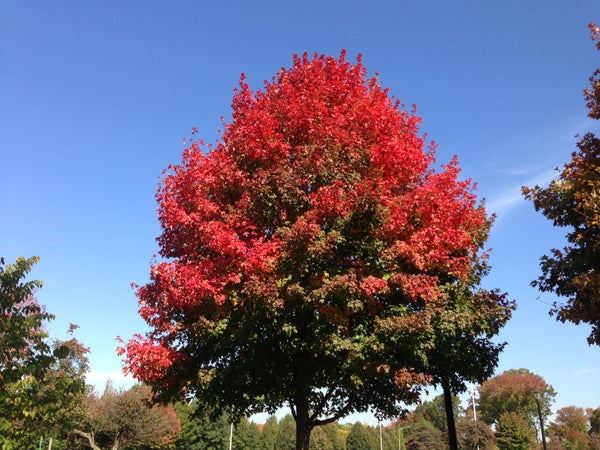

In Autumn, New England foliage turns vibrant shades of red, yellow, and orange. Which brings in lots of green—as in the money spent by tourists who flock to the region to witness the explosion of color.
Because of fall’s economic implications, exactly when the leaf-peeping season will begin is thus a source of constant speculation.
Scientists know that factors including frost, heat, rain and drought all affect the timing—but the whole colorful picture is still difficult to accurately predict.
On supporting science journalism
If you're enjoying this article, consider supporting our award-winning journalism by subscribing. By purchasing a subscription you are helping to ensure the future of impactful stories about the discoveries and ideas shaping our world today.
Now scientists have picked apart satellite imagery from two New England forest ecosystems collected from 2001 to 2012 to try to get a better handle on exactly what factors influence the autumn leaves.
The scientists looked at northeastern highlands and coastal zones. They incorporated available data on chills, frosts and heat, and rain, drought, and flooding. In general, cold, wet and extreme heat made leaves change color sooner, while moderate heat and low rainfall delayed the coloration.
But the different ecosystems behaved differently. Forests in the highlands reacted to frosts both in spring and in the fall, while the coast only responded to fall frosts. The coastal region’s forests were also particularly sensitive to rain and flooding.
Incorporating climate change predictions for the next century, the researchers propose that the highlands will change color later in the fall, while the coast may start to turn earlier. The study is in the Proceedings of the National Academy of Sciences. [Yingying Xie, Xiaojing Wang and John A. Silander, Jr., Deciduous forest responses to temperature, precipitation, and drought imply complex climate change impacts]
The researchers note that more data, such as for extreme weather events and flooding, need to be incorporated into future models. Which could help New England states maximize fall’s economic windfall.
—Cynthia Graber
[The above text is a transcript of this podcast.]
