
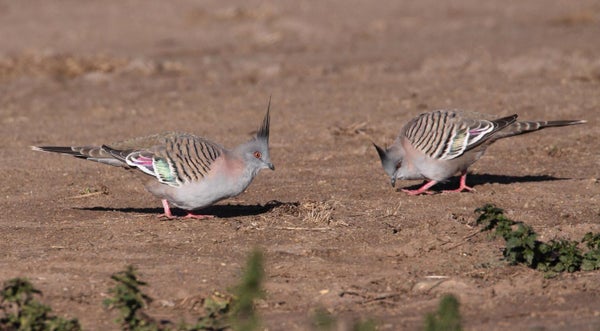

Feathers are not just for flight. They keep birds warm, become part of their nests, and help them attract mates. And for one Australian bird, feathers even help produce an important sound—an alarm.
“People had long noticed that these birds produced these loud whistles.”
Trevor Murray, a postdoctoral researcher at the Australian National University.
On supporting science journalism
If you're enjoying this article, consider supporting our award-winning journalism by subscribing. By purchasing a subscription you are helping to ensure the future of impactful stories about the discoveries and ideas shaping our world today.
“My supervisor Rob Magrath in collaboration with May Hingee thought that they were used as an alarm. So they did some playbacks and they could show quite strongly that if you play back these sounds to other birds, they flee straightaway. So what I was really interested in was following up on that research and finding out how they produce the sound, whether it is actually a signal, and whether it’s a reliable signal.”
The team focused their experiment on specific feathers in the crested pigeon’s wing. “We were able to target the eighth primary feather, which is unusually narrow—it’s about half the width of the surrounding feathers. And then we also removed, on different sets of birds, we also removed those neighboring feathers, the ninth primary feather and the seventh primary feather...and we were able to see…that the eighth primary feather, when it was missing, the high note had completely disappeared. So the eighth primary feather produced that high note and the ninth primary feather, it turns out, actually produced the low note.”
And if the birds are fleeing from danger, they produce a louder and higher tempo whistle than they do during a normal takeoff. The study is in the journal Current Biology. [Trevor G. Murray, Jochen Zeil and Robert D. Magrath, Sounds of Modified Flight Feathers Reliably Signal Danger in a Pigeon]
Murray and his colleagues did another experiment where they used the recordings they made to observe the reactions of other crested pigeons. “And from this experiment we were able to see that the eighth primary feather, the unusual feather, was actually crucial for signaling alarm. When that eighth primary feather was missing, they very rarely responded. They almost never fled. Whereas when the neighboring feather that produces the other part of the sound, that ninth primary, they actually fled just as much as to normal alarms. This shows us that this unusual primary feather is crucial for signaling alarm, and together that suggests that it has evolved to communicate with its flock mates.”
So that birds of a feather can flee together.
—Annie Sneed
[The above text is a transcript of this podcast.]
[Crested pigeon feather whistle sound courtesy of Trevor Murray.]
