
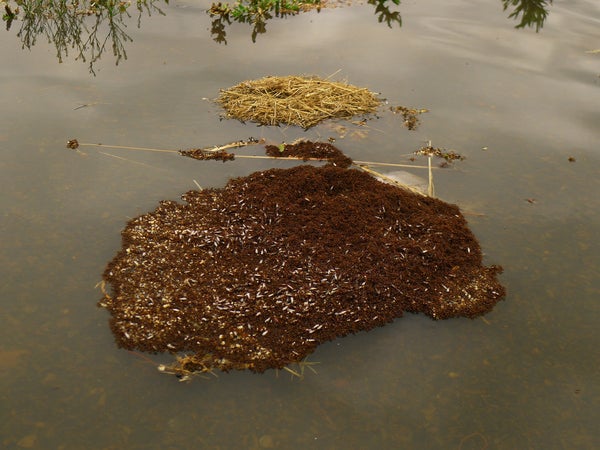

Take a fire ant—don’t forget your gloves. Toss it in water, and it’ll eventually drown. But throw a group of fire ants into the water, come back the next day, and they’ll still be floating.
Ants are known for cooperative behavior. A species of fire ant called Solenopsis invicta originated in the rainforests of Brazil. It adapted to the region’s frequent flooding by building rafts—made up of big groups of the ants themselves. These allow the ants to float, sometimes for months.
Scientists wanted to know how. They collected fire ants from roadsides in Georgia. They placed the ants in water in groups of 500, 3,000, and 8,000. The ants quickly group together. Half get stuck underneath in a single layer—but there are small pockets of trapped air that likely prevent them from drowning.
On supporting science journalism
If you're enjoying this article, consider supporting our award-winning journalism by subscribing. By purchasing a subscription you are helping to ensure the future of impactful stories about the discoveries and ideas shaping our world today.
The ants connect by gripping each others’ mandibles and claws. The scientists say it’s similar to weaving waterproof fabric. The resulting two-layer raft is cohesive, buoyant and water-repellent. The research was published in the Proceedings of the National Academy of Sciences. [Nathan Mlot, Craig Tovey, David Hu, Fire ants self-assemble into waterproof rafts to survive floods]
This discovery could help roboticists interested in building self-assembling flotation devices. Or just satisfy our curiosity about how ants cooperate to stay afloat.
—Cynthia Graber
[The above text is an exact transcript of this podcast.]

