
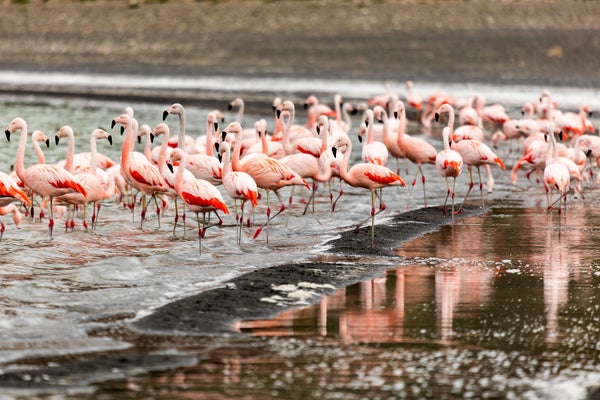

Spend some time watching flamingos, and you might think that not much goes on in their tiny heads. But these elegant avians actually lead complex social lives. Each bird has certain other individuals it prefers to spend time with and others it avoids. In other words, flamingos have friends.
The Wildfowl and Wetlands Trust, the WWT, manages a number of wetlands in the U.K., some of which have communities of captive aquatic birds, including flamingos.
“They didn’t quite know whether they could just take a flamingo out of the environment and stick it in a new flock, and it would be fine. Or should they care a bit more about the social choices that the birds were making?”
On supporting science journalism
If you're enjoying this article, consider supporting our award-winning journalism by subscribing. By purchasing a subscription you are helping to ensure the future of impactful stories about the discoveries and ideas shaping our world today.
Paul Rose, a psychologist at the University of Exeter’s Center for Research in Animal Behavior.
For five years, Rose and his team observed the daily goings-on of five of the world’s six different flamingo species, housed at the WWT Slimbridge Wetland Center in Gloucestershire. The five species are the Chilean, Andean, American, James’s and lesser flamingos.
“The partnerships that we see between birds are nonrandom. The birds are choosing who to associate with.”
Male-female pairs spend time together, but so do same-sex pairs and even groups of three or four. And those relationships can last for many years. The findings are in the journal Behavioural Processes. [Paul E. Rose and Darren P. Croft, Evaluating the social networks of four flocks of captive flamingos over a five-year period: Temporal, environmental, group and health influences on assortment]
“So there were some flamingos in the group that really didn’t care who their partner was for that day. They would flit around, and they would have many different relationships with many different birds.”
And of course, there were other flamingos that were less social butterfly and more lone wolf. But even they had a few close friends.
“Those birds that were least gregarious had more investment in a smaller number of social bonds with flamingos that they knew really well.”
Rose thinks that flamingos may have evolved their social lives due to their wetland habitats—in which the resources they need are concentrated in a small area.
“The social organization is layered on top of this need to be in one environment, so you have to be gregarious. If flamingos know their partners—if they know that these six birds, say, are friendly, and they get on with them—they can then waste less energy scrapping and squabbling with other birds that they don’t get on with.”
By spending time with their friends, flamingos can more efficiently direct their limited time and energy to activities like foraging and mating.
“If I want to go stand on one leg and preen my feathers, I’ll go and stand on my leg and preen my feathers next to Fiona, because I get on with her, rather than next to Frank, because I hate him, and we’ll just scrap."
If all this sounds familiar, well, we all know a Fiona—as well as a Frank.
—Jason G. Goldman
[The above text is a transcript of this podcast.]
