
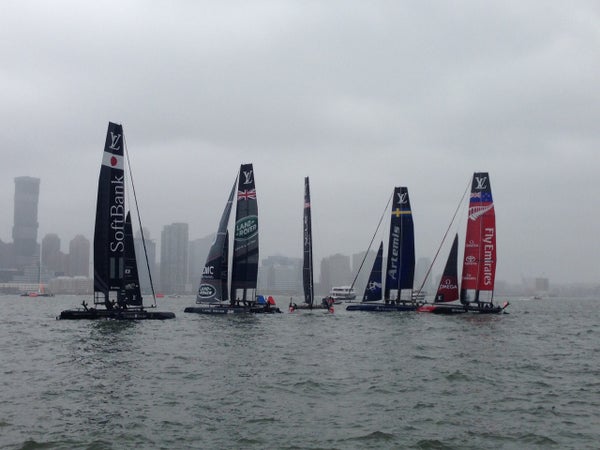

“Land Rover in some better breeze at the moment…flying a hull, making some good distance back now in that breeze in the middle of the course that has slowly materialized.”
Lee McMillan, second helmsman for the Land Rover Ben Ainslie Racing America’s Cup team. He was calling one of the races in the America’s Cup World Series New York session, in the Hudson River on Friday, May 6th.
Before the races, Martin Whitmarsh talked about some of the technology of these boats. He was a mechanical engineer before becoming CEO of McLaren Racing and then CEO of the team that will try to win the America’s Cup for England in 2017.
On supporting science journalism
If you're enjoying this article, consider supporting our award-winning journalism by subscribing. By purchasing a subscription you are helping to ensure the future of impactful stories about the discoveries and ideas shaping our world today.
“We call them boats, we call them yachts, when they’re flying less than 1 percent of the surface area is in water, 99 percent is in the air. So these are very aerodynamic boats.”
“So we are in a program now which goes towards Bermuda next year for the 35th America’s Cup challenge. So we are one of the challengers to Oracle Team USA. And we are in a process here in New York of competing with what is called an AC-45, so the boats we have here, they have wings, they’re a hydrofoiling catamaran…but everyone is using the same boats…and the winner of this series, the World Series, gets points that go forward into the qualifying process.
“At the end of this year, we will launch the Cup Class boats. So these will be about twice the power...the sailors are down in cockpits, unlike today. A lot of the power is being generated by these four grinders that are providing hydraulic power, and that energy is being used to control the flying surface, the hydrofoil…and is also being used to control the wing and the flaps, effectively the engine, of what we have.
“So these Cup Class boats…they will be in Bermuda traveling at speeds of 85 kilometers an hour. These are about 3.5 tons that’ll be flying on a hydrofoil that’s not much more than a meter wide. So it’s a fairly incredible piece of technology. And as the sailors develop their technique you’ll see these staying in the air, jibing from one hydrofoil onto the other hydrofoil and staying in the air. It’s an incredible piece of technology, athleticism, and choreography on the part of the sailors, and skill of course.”
The boats that raced in New York—the AC-45s—are 45 feet long and identical for each team. But there will be some opportunity for slight differences in the larger AC-72 boats used next year in Bermuda. And applying advanced technology to those nonfixed areas could be the difference between winning the Cup or hoping to try again in 2021.
“There’s a lot of challenge…but whilst we’re racing here, there’s a technology race that’s going on.”
—Steve Mirsky
[The above text is a transcript of this podcast.]
