
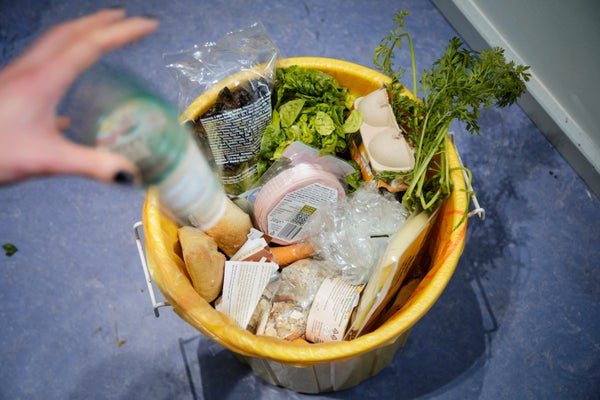

“Best before,” “sell by,” “for best results, use by.” You probably have many of these labels on items in your fridge and pantry right now.
“A lot of behavior on what you throw away and how you consume food, a lot of people go off what’s on the label. And so what we’re looking at is trying to shift behavior, trying to make consistency in terms of how foods are labeled so that we can avoid waste and avoid people throwing away products that are perfectly good to eat.
Pete Pearson is the senior director for food loss and waste at World Wildlife Fund.
On supporting science journalism
If you're enjoying this article, consider supporting our award-winning journalism by subscribing. By purchasing a subscription you are helping to ensure the future of impactful stories about the discoveries and ideas shaping our world today.
“Seventy percent or more of the biodiversity loss on the planet is attributed to food and agriculture.”
The Natural Resources Defense Council estimates that 40 percent of all food in the United States goes uneaten. That translates to some $218 billion in wasted money annually. Beyond the hit to the wallet, food waste in landfills creates methane, which is a more potent greenhouse gas than carbon dioxide. And these figures don’t include a full accounting of the accumulated waste producing and transporting food that we don’t eat; water and fertilizer; maintenance of animal habitats; and fuel.
“And often, because of labeling and consumer behavior, we throw it away, and it’s still perfectly good to eat.”
Another part of the solution could come from the bipartisan Food Date Labeling Act, which would expand federal standards on expiration dates from just baby formula now to most everything. The bill is making its way through Congress and could streamline what you see when you’re shopping. Part of the goal? To reduce customer confusion.
“What they’re trying to do is introduce a series of binding federal standards. In some cases, this is done by states and local jurisdictions. And so what you have is a big confusion and inconsistency in terms of the language.”
The House bill recommends a label of “Best if Used by” for when a product’s quality or freshness may start to worsen and then “Use by” for when it’s definitely time to get rid of it. And Pearson recommends, well, a little bravery:
“So I found that as a food-waste leader and the director of a program, I find that I’m eating a lot of foods that most people probably wouldn’t. And we need more food-waste warriors. We need people that are willing to cut the mold off of cheese or scrape some fuzz out of the sour cream. Because it’s not gonna detract anything from the actual product. And you will survive; you’re not gonna die. And you’re gonna save food and help save the environment in the process.”
—Jared Rizzi
[The above text is a transcript of this podcast.]
