
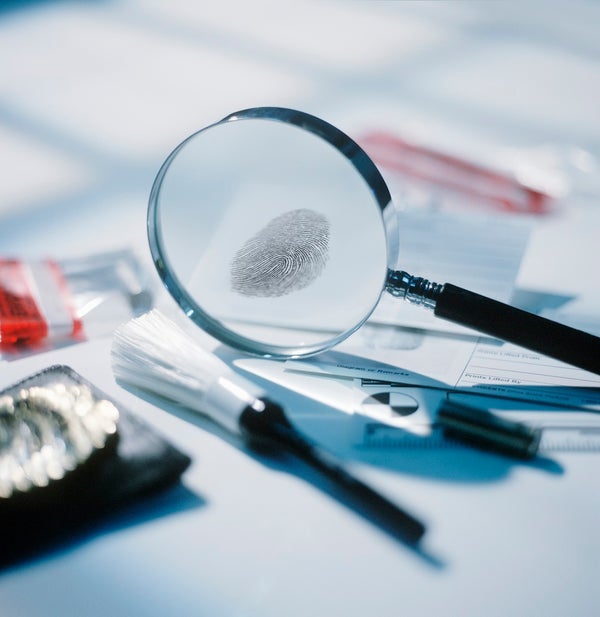

“We have increasing doubts about this evidence, but we don’t feel yet that we have the scientific knowledge and basis to exclude it altogether.”
Jed Rakoff, United States District Judge for the Southern District of New York. He spoke about forensic evidence—and the need for it to actually be based in science—at the annual meeting of the American Association for the Advancement of Science in Boston on February 18th.
On supporting science journalism
If you're enjoying this article, consider supporting our award-winning journalism by subscribing. By purchasing a subscription you are helping to ensure the future of impactful stories about the discoveries and ideas shaping our world today.
“Most fundamentally…the report said that what was really lacking was testing and research. And thus they questioned whether any of this could be called science and they also questioned whether it was really that accurate…
But forensic evidence is still widely admitted, even when the science behind it may be lacking.
I think courts continue, despite their doubts, to admit this evidence…and that is still the feeling…that, eh, it’s still better than nothing, it’s still useful evidence, it has some degree of objectivity that’s not present in much lay testimony. And therefore it is useful. The problem of course is it comes heralded as science, and that gives it a weight that is probably disproportionate.
I had a case, this was before the National Academy report, but it’s sort of illustrative of what I’m talking about…United States versus Glynn. In that case, the government put on a tool-mark expert to testify that the markings on the shell that had been found at the scene of the crime matched the markings inside the barrel of the gun that had been found under the defendant’s bed…and I asked him, for example, what’s your error rate and what’s the error rate of this methodology that you’re using. And he said zero. And I said zero? And he said yes. And I said how can it be zero. And he said well, in every case I’ve testified, the guy’s been convicted.”
—Steve Mirsky
[The above text is a transcript of this podcast.]
