

Freeloaders. They just sit around while their hard-working colleagues get things done. But might freeloaders actually be necessary for society to function efficiently? The answer could be yes—at least when it comes to fire ants and their efforts to dig nests underground.
“Fire ants are quite common in Georgia and in fact most of the bottom third of the U.S., having come here in the '30s from South America.”
Daniel Goldman, a physicist at Georgia Tech. Fire ants are highly social organisms. So, Goldman and his colleagues wanted to know how individual ants knew what to do without a central leader issuing orders.
On supporting science journalism
If you're enjoying this article, consider supporting our award-winning journalism by subscribing. By purchasing a subscription you are helping to ensure the future of impactful stories about the discoveries and ideas shaping our world today.
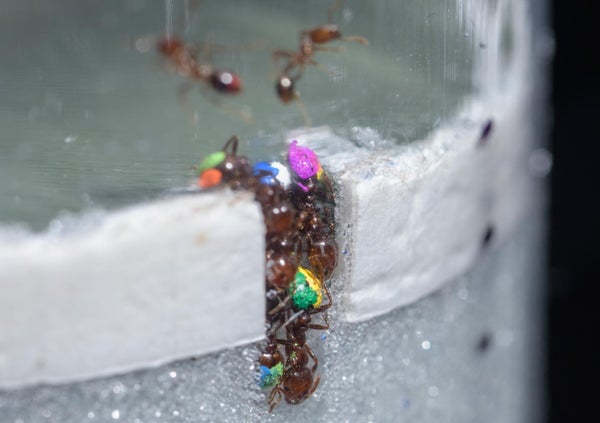
To find out, Goldman’s team labeled individual fire ants with paint and then watched them dig their slender tunnels—barelywide enough for two workers. Turns out, just 30 percent of the ants did 70 percent of the labor. “I was surprised that we ended up with so few workers actually doing the work at any one time.”
A quarter of the ants never even entered the tunnel. Others crawled inside, but left without excavating a single grain of dirt. These idling and retreating behaviors ensured the crowded tunnels did not get clogged with insect traffic, which would grind the construction process to a halt.
And when the scientists removed the five hardest-working ants from the colony, others immediately jumped in to compensate—with no reduction in the group’s productivity. Seems that it doesn’t matter which ants are working or freeloading at a given time, as long as there is some division of labor to keep the tunnels flowing smoothly. The findings are the journal Science. [J. Aguilar et al., Collective clog control: Optimizing traffic flow in confined biological and robophysical excavation]
Goldman’s team also modelled the ants’ nest-building on computers. And the most efficient excavation happened in the simulations where the electronic ants behaved similarly to their live counterparts.
The study could have implications for robotics. Imagine groups of robots sent to search rubble for disaster survivors. Or nanobots coursing through our bodies to diagnose illness and deliver targeted medical treatment. Such robot swarms will need to avoid getting jammed up in tight spaces. It might be necessary to program them so some just sit back and watch their comrades work.
—Daniel Ackerman
[The above text is a transcript of this podcast.]
