
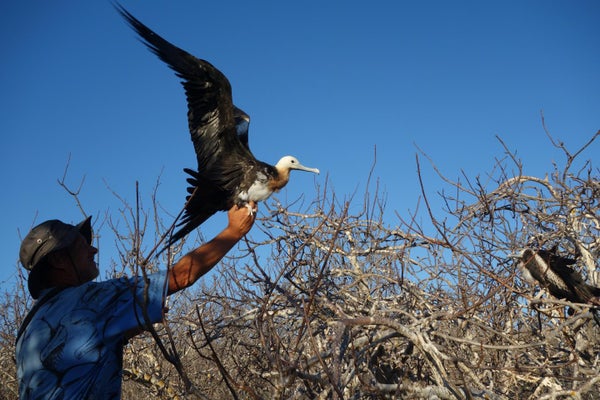

Great frigate birds are extraordinary creatures. They’re seabirds with six-foot wingspans, yet they weigh only about three pounds. Their preferred food: flying fish—which they pluck out of the air above the water’s surface. Frigate birds’ feathers aren’t waterproof, so landing on the water to fish is a no-go.
Now, scientists have discovered that great frigate birds do something else amazing: they can fly for up to two months at a time without landing.
Researchers already knew that these birds took extended trips over the Indian and Pacific Oceans to feed. But in a new study, scientists used tracking devices to follow the movement and vital signs of birds from the island of Europa, near Madagascar. They discovered that the birds have a highly specialized strategy for staying aloft.
On supporting science journalism
If you're enjoying this article, consider supporting our award-winning journalism by subscribing. By purchasing a subscription you are helping to ensure the future of impactful stories about the discoveries and ideas shaping our world today.
“When they are traveling, most of the time, they flap very infrequently their wings.
Henri Weimerskirch, an ecologist at the National Center for Scientific Research in France.
“In fact, what they are doing, they are doing sort of a roller coaster flight where they take altitude. Even they can climb up to 3,000 or 4,000 meters, and when they climb, they do not flap their wings at all.”
Weimerskirch and his colleagues found that the birds climb currents of rising air associated with cumulus clouds, circling upwards the way hawks and vultures do over land. Then they glide back down again, hardly flapping. By using atmospheric conditions to their advantage, the birds covered an average of 420 kilometers a day almost effortlessly. The study is in the journal Science. [Henri Weimerskirch et al., Frigate birds track atmospheric conditions over months-long transoceanic flights]
The researchers also discovered that the birds endure some harrowing conditions on their voyage, including some thrills and chills.
“When you enter into the clouds, there’s a lot of turbulence. After, when you see from the recording on the logger of the bird, when they are at 4,000 meters, the temperatures are negative. It’s a tropical bird. It’s a bird that has no specific down like geese that are operating in the Arctic. So they are encountering sort of a polar temperature, but it’s a typical tropical bird.”
Of course, the birds have to eat during their journey. The researchers found that diving down to the sea surface to snatch a meal consumed most of the birds’ energy, even though it only occupied about 10 percent of their time.
“When they are climbing, they have a period where there is no movement at all during several minutes. And so, during this time is probably the time when they are sleeping.”
That’s right—like many others who make long-distance flights, great frigate birds catch a little shut-eye along the way.
—Julia Rosen
[The above text is a transcript of this podcast.]
