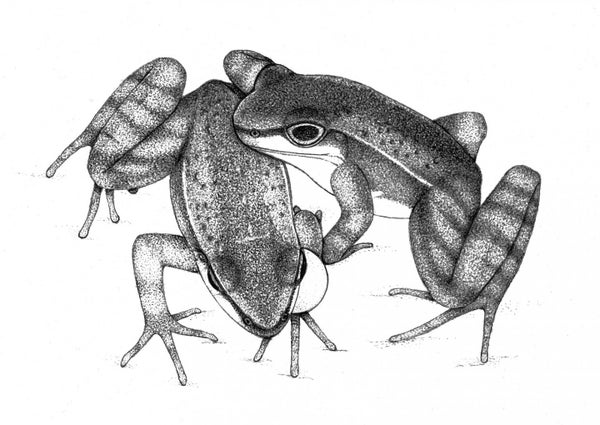
Frogs Signal Visually in Noisy Environments

The Brazilian torrent frog has the most sophisticated visual communications system yet documented for a frog species.


de Sá et al.

Illustration of a Bohr atom model spinning around the words Science Quickly with various science and medicine related icons around the text

Join Our Community of Science Lovers!

Ask anyone what sound a frog makes and they'll probably say "ribbit." But there’s only one frog that makes that sound: the Pacific chorus frog. It may have become the go-to frog call because it just happens to live near sound artists in Hollywood.

Herpetologists have long known that frog calls are more diverse than just ribbit. But their communications are more diverse than just calls—they also signal each other by sight.

Say you’re a male of a species called the Brazilian torrent frog. And you live alongside a fast-flowing stream in the Amazon jungle. You happily chirp away, advertising your availability to whatever female torrent frogs are around. But when another male comes too close, your chirps give way to peeps and squeals.


On supporting science journalism

If you're enjoying this article, consider supporting our award-winning journalism by subscribing. By purchasing a subscription you are helping to ensure the future of impactful stories about the discoveries and ideas shaping our world today.


So you wave your red and brown arm in front of your cream-colored face. The ensuing color contrast turns your body into a warning light. The intruder gets the hint and hops away to bother someone else.

Brazilian zoologist Fábio P. de Sá witnessed Brazilian torrent frogs using eighteen different visual displays, five of which had never been seen before in other frogs. He and colleagues published their findings in the journal PLOS ONE. [Fábio P. de Sá, Juliana Zina and Célio F. B. Haddad, Sophisticated Communication in the Brazilian Torrent Frog Hylodes japi]

The frog semaphore system probably developed because streams are noisy places. Instead of shouting over the sound of rushing water, these frogs communicate by jumping, head bobbing, arm waving or even wagging their toes.

The set of signals is the most sophisticated ever documented for a frog, but de Sá thinks that other frogs could have similarly complex repertoires, if only researchers would take the time to look. One thing is certain: it’s not easy being green, but it’s simple to be seen.

—Jason Goldman

[The above text is a transcript of this podcast.]

Jason G. Goldman is a science journalist based in Los Angeles. He has written about animal behavior, wildlife biology, conservation, and ecology for Scientific American, Los Angeles magazine, the Washington Post, the Guardian, the BBC, Conservation magazine, and elsewhere. He contributes to Scientific American's "60-Second Science" podcast, and is co-editor of Science Blogging: The Essential Guide (Yale University Press). He enjoys sharing his wildlife knowledge on television and on the radio, and often speaks to the public about wildlife and science communication.

More by Jason G. Goldman

It’s Time to Stand Up for Science

If you enjoyed this article, I’d like to ask for your support. Scientific American has served as an advocate for science and industry for 180 years, and right now may be the most critical moment in that two-century history.

I’ve been a Scientific American subscriber since I was 12 years old, and it helped shape the way I look at the world. SciAm always educates and delights me, and inspires a sense of awe for our vast, beautiful universe. I hope it does that for you, too.

If you subscribe to Scientific American, you help ensure that our coverage is centered on meaningful research and discovery; that we have the resources to report on the decisions that threaten labs across the U.S.; and that we support both budding and working scientists at a time when the value of science itself too often goes unrecognized.

In return, you get essential news, captivating podcasts, brilliant infographics, can't-miss newsletters, must-watch videos, challenging games, and the science world's best writing and reporting. You can even gift someone a subscription.

There has never been a more important time for us to stand up and show why science matters. I hope you’ll support us in that mission.

Thank you,

David M. Ewalt, Editor in Chief, Scientific American

Subscribe