
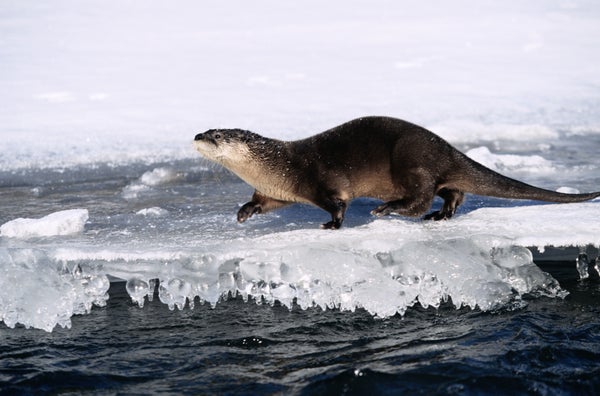

Whales, seals and walruses stay warm in chilly water because they have a thick layer of blubber. We humans rely on something like blubber—neoprene rubber wet suits—to spend time in cold water. But the thick versions for really icy water are heavy and ungainly. So rather than taking after big marine mammals, what if we could learn from the littler ones, like beavers and otters?
“These animals are quite small and they can't carry around a thick layer of blubber. So instead they have fur that is evolved to trap air, and this air provides a layer of insulation for them in water.”
Alice Nasto is a graduate student in mechanical engineering at MIT. Scientists have known about this air-trapping insulation mechanism for a long time, but they had not teased out the details of how it works. So Nasto and her colleagues took on the challenge.
On supporting science journalism
If you're enjoying this article, consider supporting our award-winning journalism by subscribing. By purchasing a subscription you are helping to ensure the future of impactful stories about the discoveries and ideas shaping our world today.
“We're creating these furry samples from these rubbery materials by laser cutting molds and casting these hairy surfaces. And through our approach we can precisely control the spacing of the hairs [and] the length of the hairs.”
The researchers then created a system to gather data when their pelts entered and moved through a liquid—in this case not water, but silicone oil, which makes it easier to see air bubbles. The key is to keep the pelt’s air layer intact.
“So when they're crossing the air water interface, initially their hairy texture is full of air. And then you go into water. How much of the air comes down with you as you're moving in through the interface. So that's what this model will tell you.”
They found that the denser the hairs, the more the air gets trapped. Which should keep the animal—or potentially the human in a future furry wet suit—warm. The research is in the journal Physical Review Fluids. [Alice Nasto et al., Air entrainment in hairy surfaces]
“What we would like to work on moving forward is understanding how, after you dive into the water, how do you maintain this air layer trapped in your fur. And there's lots of interesting properties of the fur in nature that we haven't yet looked at in our model that could help explain how this mechanism might work.”
So for now, cold-water divers and surfers will still emulate seals or sea lions. But the day may come when they’ll more closely resemble otters or beavers. Or even a Wookiee on a boogie board.
—Cynthia Graber
[The above text is a transcript of this podcast.]
