

“It’s not just gamblers using science. In many cases, science has benefited enormously from people studying the house.”
Mathematician Adam Kucharski. He’s the author of the new book The Perfect Bet: How Science and Math Are Taking the Luck Out of Gambling.
“Back in the Renaissance, actually, probability theory was developed to study these games. I mean, can you imagine having bets where it’s not actually clear what a fair game is?”
On supporting science journalism
If you're enjoying this article, consider supporting our award-winning journalism by subscribing. By purchasing a subscription you are helping to ensure the future of impactful stories about the discoveries and ideas shaping our world today.
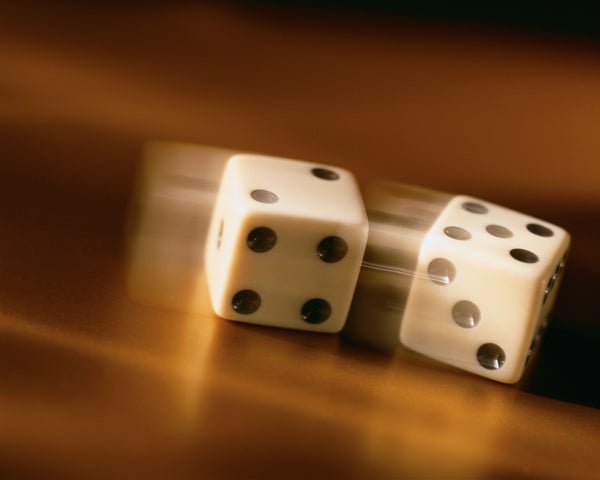
For example, in the 17th century the question came up, do you have the same chance of throwing a six by rolling one die four times or of throwing two sixes by rolling two dice 24 times?
“That had been around awhile, those kinds of bets and those kinds of questions, and that was Fermat and Pascal who developed a lot of this theory. And one of the crucial things was this concept of an expected value: if you play a game repeatedly what do you expect to win on average? And until you have that kind of theory in place it’s very hard to actually compare two bets directly and work out which one is more preferable.”
Pascal figured out that your chances of throwing one six in four rolls of a die was slightly more than 50 percent. But your odds of two sixes in 24 throws of two dice was slightly less than 50 percent.
“And a lot of this theory from probability to statistics and actually more recently things like game theory and chaos theory originated with studying games of chance, so I think science actually has benefitted a lot from people’s curiosity about gambling.”
My full interview with Adam Kucharski about his book The Perfect Bet is at our Web site as a Science Talk podcast.
—Steve Mirsky
[The above text is a transcript of this podcast.]
