
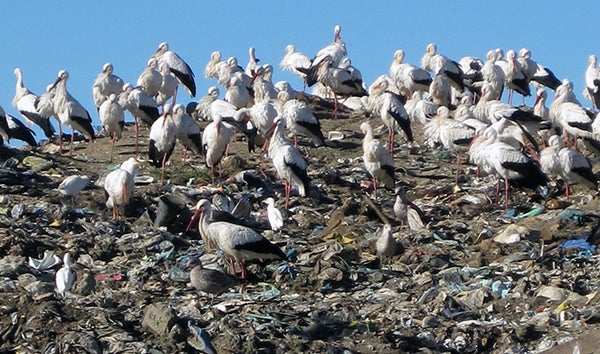

Humans aren’t the only creatures who love junk food—many animals are known to enjoy sifting through our garbage to find edible treats. And now we learn that some storks have stopped migrating from Europe to sub-Saharan Africa in the winter—they’d rather feed at landfills.
“They use landfill sites heavily during the winter and they travel very long distance to get to the sites.”
Aldina Franco of the University of East Anglia, one of the scientists who studied the storks’ use of landfills in Portugal. GPS tracking devices on 17 birds showed that the landfill life might mean up to 100-kilometer round-trips to feed—healthy distances, but far shorter than their historic migration routes.
On supporting science journalism
If you're enjoying this article, consider supporting our award-winning journalism by subscribing. By purchasing a subscription you are helping to ensure the future of impactful stories about the discoveries and ideas shaping our world today.
“And also they use the nests throughout the year and look after the nests. So these resident birds are in perfect condition, they are always ready to start breeding. So as soon as spring arrives they’re ready to go, the nest is in good condition, and they start breeding earlier.”
The number of storks overwintering in Portugal has shot up from fewer than 2,000 in 1995 to 14,000 in 2014. The increase appears to reflect both changes in behavior and a booming stork population in general. The study is in the journal Movement Ecology. [Nathalie I. Gilbert et al, Are white storks addicted to junk food? Impacts of landfill use on the movement and behaviour of resident white storks (Ciconia ciconia) from a partially migratory population]
The Portuguese landfills are slated to close in 2018, with the trash diverted to covered recycling and composting facilities. How will the storks respond? Franco thinks they’ll get back to basics.
“So the storks are social animals. They live in colonies. They migrate in groups. So potentially as long as there are a few birds that still know the route, they can teach the ones that are currently residents how to migrate.”
—Cynthia Graber
[The above text is a transcript of this podcast.]
