
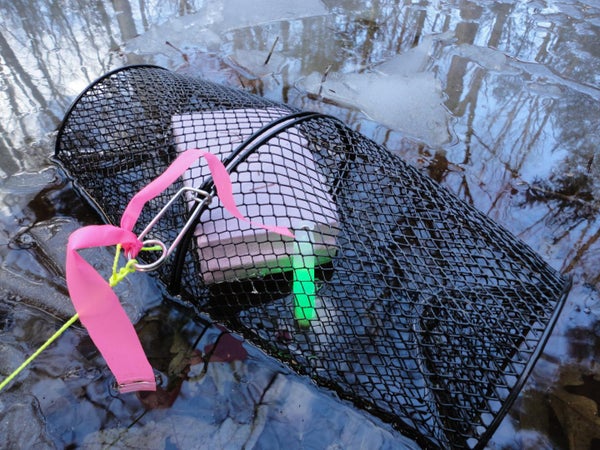

Populations of frogs, salamanders and other amphibians are declining around the world—even in protected areas, like U.S. national parks. Ecologists needed a simple method to track the animals’ numbers. Now, researchers have found an effective way to keep tabs on amphibians—using that concert and party favorite: glow sticks. Green glow sticks, to be specific.
“What we do know is that their eyes are particularly sensitive to green light.”
David Munoz, a PhD candidate in the ecology program at Penn State University.
On supporting science journalism
If you're enjoying this article, consider supporting our award-winning journalism by subscribing. By purchasing a subscription you are helping to ensure the future of impactful stories about the discoveries and ideas shaping our world today.
To test the idea, Munoz and colleagues set up minnow traps with and without glow sticks at a dozen vernal pools in Centre County, Pennsylvania. The critters gather at the pools to breed.
For a month, they trapped and tracked numbers of the Jefferson salamander, the spotted salamander, the wood frog and the eastern red-spotted newt. “Right before we left for the day, around 4 P.M., we’d activate the glow stick and hang it on the little minnow trap, come back the next day to see what we got.”
Traps with glow sticks were vastly more productive. “We were really surprised by how strong of an effect our glow sticks had on our captures. So, by just putting a glow stick in one of these minnow traps we increased the capture rates for our spotted salamanders and our Jefferson salamanders between on average two to four times.” And for the eastern red-spotted newt, the glow stick traps lured six times as many. [Michael Antonishak, David A. W. Miller and David J. Munoz, Using Glow Sticks to Increase Funnel Trap Capture Rates for Adult Vernal Pool Amphibians, in Herpetological Review]
“You know, these salamanders and these amphibians are going to these sites to breed. And so what are they looking for? They’re looking for other individuals…and so what we think is that the glow stick is either making the movement of other salamanders more apparent, or it's potentially just a simple visual cue…their eyes are sensitive to this type of light, so they might be attracted to it.”
Regardless of the reason, Munoz hopes his team’s glowing discovery will benefit amphibians. “In order to help manage those species, and help bring them back, or reverse those declines, we need to understand what’s causing those declines. And the way we do that is by monitoring populations.”
Another nice thing about glow sticks: they’re cheap. “It gives scientists a new tool, and essentially a better tool to help achieve that monitoring on a cost effective basis.”
—Annie Sneed
[The above text is a transcript of this podcast.]
