

Insects can be noisy. But most of the sounds they produce, we can’t hear. Take tiny insects called treehoppers. They communicate by producing vibrations. When a male treehopper is hunting for a mate, he vibrates his body to produce a special love song.
“They sound like oooo-boo-boo-boop.”
Kasey Fowler-Finn is an assistant professor of biology at Saint Louis University. She says if a female treehopper is interested, she’ll vibrate back to the male. Basically, her way of saying, “Hey, there.”
On supporting science journalism
If you're enjoying this article, consider supporting our award-winning journalism by subscribing. By purchasing a subscription you are helping to ensure the future of impactful stories about the discoveries and ideas shaping our world today.
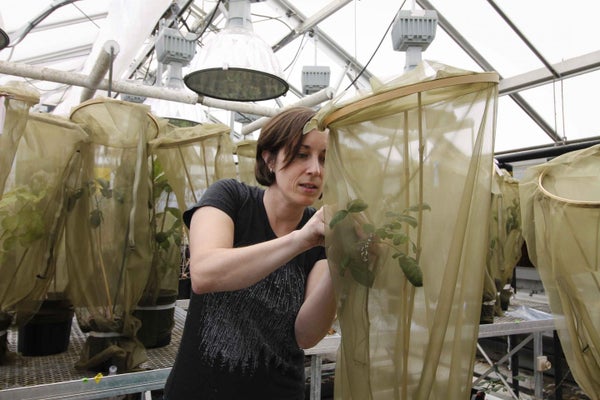
Fowler-Finn wondered if treehopper mating songs might change at different temperatures, which could affect whether the species survives as the climate changes. So she and graduate student Dowen Jocson built custom incubators, using plywood and Ikea shelves—plus, a laser that helps them listen to treehoppers.
“The laser receives information about these tiny vibrations on the plant stem, which we then amplify and process into sounds that we can hear.”
Turns out, the treehoppers do sound different when the temperature changes. Here’s a male singing at 65 degrees.
[CLIP: Insect sound]
And another at 97 degrees.
[CLIP: Second insect sound]
But that’s not all. The team recorded these songs and played them for females to see if they still found them attractive.
“So essentially, we’re having a conversation with the insect, because we can play back a bunch of different signals to females and ask her how much she likes each one.”
As male treehopper love songs changed across temperatures, females still recognized them—saying, “Yep, I’m interested in mating with you.” Jocson says that was exciting.
“I think when we saw that, we were just like, ‘Wow, this is awesome.’”
The study is in the Journal of Evolutionary Biology. [Dowen Mae I. Jocson et al, Temperature coupling of mate attraction signals and female mate preferences in four populations of Enchenopa treehopper (Hemiptera: Membracidae)]
She says this just one piece of the puzzle. But it gives her some hope that treehoppers and other similar insect species will keep things steamy—even as the climate warms.
—Shahla Farzan
[The above text is a transcript of this podcast.]
[A version of this story originally aired on St. Louis Public Radio, the NPR member station serving eastern Missouri and portions of western Illinois.]
