
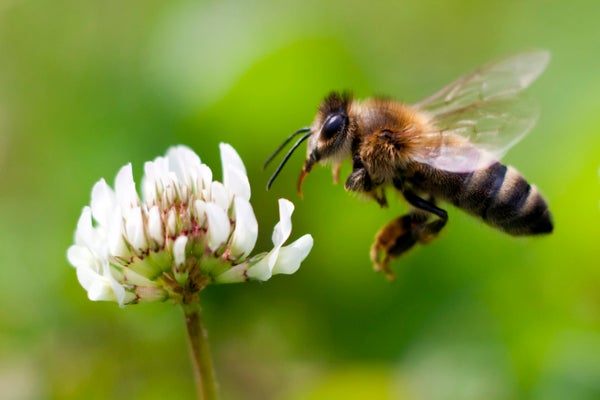

It takes a big brain—a human brain—to do math. Or so you might assume. But scientists have found that other animals, such chimpanzees, monkeys, and even pigeons can perform some addition and subtraction. Now new research shows that honeybees—with brains the size of sesame seeds—can perform basic math.
Researchers put honeybees through 100 trials to train them to add and subtract. They put the bees in a Y-shaped maze and presented them with a certain number of either yellow or blue shapes. Yellow indicated the bee should subtract, while blue meant they should add.
The bee then entered the “decision chamber,” where it was presented with a correct answer on one side and an incorrect answer on the other side. If they picked the right answer they were rewarded with a sugary solution. If not, they got bitter tonic water. The researchers also put the bees through another test trial without a reward or punishment to make sure there weren’t any scent marks influencing the bees’ choices.
On supporting science journalism
If you're enjoying this article, consider supporting our award-winning journalism by subscribing. By purchasing a subscription you are helping to ensure the future of impactful stories about the discoveries and ideas shaping our world today.
At first the bees picked answers at random. “You see that the ability of the bees to do it starts at about chance level, 50%, showing us the bees are just choosing randomly. Over time, competence comes up to about 80%, so they actually start to perform quite well.”
Scarlett Howard, one of the study authors and a postdoctoral research fellow in neurobiology and cognition at Paul Sabatier University in France. She says the bees were even able to add and subtract correctly when presented with a number they had never seen before. The study is in the journal Science Advances. [Scarlett Howard et al., Numerical cognition in honeybees enables addition and subtraction]
“Things like this let us know there’s a lot of complexity there and their brains might not be as simplistic as we once thought.”
—Annie Sneed
(The above text is a transcript of this podcast)

