

This is Scientific American’s Science Talk. I’m Steve Mirsky, on October 7, 2019.
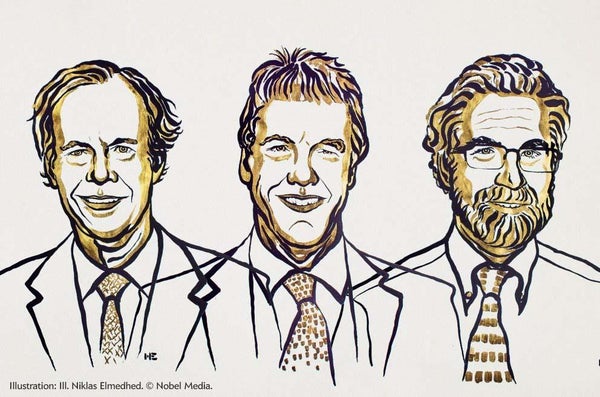
“The Nobel Assembly at Karolinska Institute has today decided to award the 2019 Nobel Prize in Physiology or Medicine jointly toWilliam Kaelin, Sir Peter Ratcliffe and Gregg Semenza for their discoveries of how cells sense and adapt to oxygen availability.”
Thomas Perlmann, secretary of the Nobel Assembly, shortly after 5:30 A.M. (Eastern Time).
On supporting science journalism
If you're enjoying this article, consider supporting our award-winning journalism by subscribing. By purchasing a subscription you are helping to ensure the future of impactful stories about the discoveries and ideas shaping our world today.
“Gregg Semenza was born in 1956 in New York. He performed his prizewinning studies at Johns Hopkins University in Baltimore, where he’s still active. Sir Peter Ratcliffe was born in 1954 in Lancashire in the U.K. He performed his prizewinning studies at Oxford University. And he’s continuing to do his research at Oxford University, and he’s also at the Francis Crick Institute in London. And William Kaelin, born in 1957 in New York—he performed his prizewinning studies at the Dana-Farber Cancer Institute in Boston, where he’s still active in his own lab.”
MORE PERLMANN AND JOHNSON
Before things get too complicated, I want to jump to an interview Randall Johnson did after the Nobel announcements. Johnson’s own research is on the effects of low oxygen, so he really knows his stuff. He spoke to an unidentified interviewer, but based on the programs in past years, I believe she was Swedish journalist Joanna Rose.
THE INTERVIEW
Okay, now back to Johnson during the earlier announcement for some nuts and bolts about oxygen sensing in cells.
MORE FROM THE ANNOUNCEMENT AND PRESS CONFERENCE
We plan to be back tomorrow with coverage of the Nobel Prize in Physics.
