
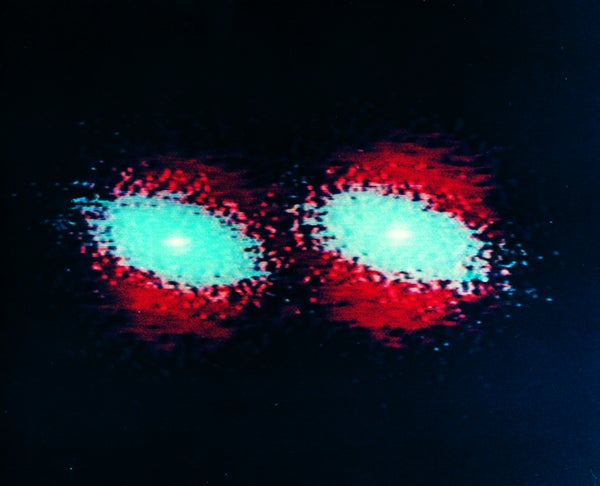

In 2016 the Laser Interferometer Gravitational-Wave Observatory, LIGO, made the first accepted detection of gravitational waves.
“So any time you move a mass it produces a gravitational wave…so black holes, like the ones LIGO detected, these are stellar mass black holes, about 10 times the mass of the sun. When they’re in orbit they’re accelerating constantly, so constantly producing gravitational waves.”
Sarah Burke Spolaor, of the National Radio Astronomy Observatory in New Mexico, at the annual meeting of the American Association for the Advancement of Science in Boston on February 18th.
On supporting science journalism
If you're enjoying this article, consider supporting our award-winning journalism by subscribing. By purchasing a subscription you are helping to ensure the future of impactful stories about the discoveries and ideas shaping our world today.
For gravitational waves produced by the acceleration of even bigger masses, we’re going to need what’s called the Laser Interferometer Space Antenna, or LISA.
“Now if you think of much bigger masses, something like a million times the mass of the sun, these things are moving much more slowly, much more far apart, and they’re producing lower frequency gravitational waves. And this is what LISA can detect. So LIGO, which is operating at these very fast orbits, fast frequencies, is unable to detect these things that are moving much more slowly and are on a much bigger scale.”
And for even bigger masses, you get to what Burke Spolaor is working on: Pulsar Timing Arrays.
“What we do with this technique is use radio telescopes to observe pulsars, which are neutron stars that are rotating very rapidly and sending their beams of emission across Earth, several hundred times per second…and the idea is of course if a gravitational wave is passing through Earth, the gravitational wave is stretching and squeezing our space time. And the tick that we see from these very, very regularly spinning pulsars is speeding up and slowing down.
“Just like we can scale the stellar mass black holes that LIGO can detect, to very, very intermediate mass very large black holes that LISA can detect, Pulsar Timing Arrays will probe the very massive end of this distribution and the most massive, so the billion to even 10 billion solar mass binary black holes in the universe. So every time you get a galaxy merger you can get a binary supermassive black hole, which then will contribute signal to our Pulsar Timing Arrays by propagating through the galaxy.
“Of course, gravitational waves does not stop at detection. What we really want to do is astrophysics with gravitational waves. And use it as a new tool to observe the universe and understand our place in it.”
—Steve Mirsky
[The above text is a transcript of this podcast.]
