
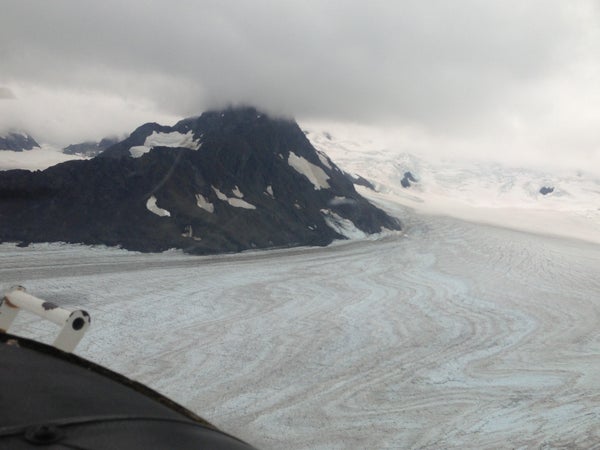

Welcome to Scientific American’s Science Talk, posted on July 21, 2019. I’m Steve Mirsky. And while much of the lower 48 is sweltering, things are somewhat cooler in Alaska. Not as cool as they should be, but anyway. Back in January, we brought you part 1 of a report from the ice fields near Juneau. Part 2 is coming up. But I’m gonna play part 1 again first for anyone who missed it or wants to get a refresher. And the beauty of podcasts is: if you wanna jump ahead to part 2, just skip ahead 10 minutes.
PART 1: Elizabeth Case is a graduate student studying glaciology at the Lamont-Doherty Earth Observatory, part of Columbia University’s Earth Institute. In the summer of 2018 she headed out onto the ice fields near Juneau, along with her mentor, Columbia earth scientist Jonny Kingslake, as part of the Juneau Icefield Research Program, or JIRP. She brought her trusty recorder and sent back audio. She mentions Seth Campbell, he’s at the University of Maine and is the director of JIRP. She also brings up Bradley Markle, who’s a postdoc at Caltech, and Wilson Clayton, formerly an environmental engineer and visiting faculty member at JIRP. Here’s part 1 of her story of doing science on the ice ... on the ice. REST OF PART 1
Here's Part 2
On supporting science journalism
If you're enjoying this article, consider supporting our award-winning journalism by subscribing. By purchasing a subscription you are helping to ensure the future of impactful stories about the discoveries and ideas shaping our world today.
PART 2
And this past week, just before she headed out onto the ice again, I spoke to Elizabeth Case about last year and the plans for this trip.
UPDATE
That’s it for this episode. Get your science news at our Web site, www.ScientificAmerican.com, where we’ve got a shipload of space stories on the site to celebrate the 50th anniversary of Apollo 11.
And follow us on Twitter, where you’ll get a tweet whenever a new item hits the Web site. Our twitter name is @sciam. For Scientific American’s Science Talk, I’m Steve Mirsky. Thanks for clicking on us.
