
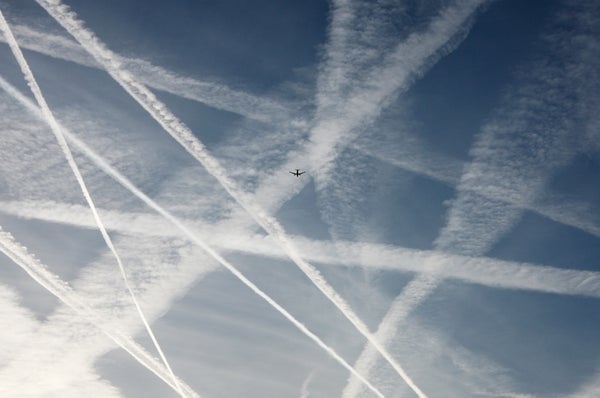

Airplanes account for about 3 percent of the climate-altering carbon dioxide emissions we add to the atmosphere. But planes are warming the planet in another way.
“So if you look up in the sky, you probably see, at some point, an aircraft. And behind that aircraft are white, fluffy streaks. And that’s what we call a contrail.”
Imperial College London engineer Marc Stettler.
On supporting science journalism
If you're enjoying this article, consider supporting our award-winning journalism by subscribing. By purchasing a subscription you are helping to ensure the future of impactful stories about the discoveries and ideas shaping our world today.
Contrails are made up of ice crystals that form when aircraft engines emit exhaust that hits the cold air. The ice crystals reflect incoming light from the sun back into space, which has a cooling effect on the atmosphere. But the contrails also stop heat coming up from the ground from escaping into space.
“It’s reflected back down toward the ground. And so that’s a warming effect.”
Stettler says, on balance, contrails warm the atmosphere more than they cool it.
“And that’s primarily because the cooling effect due to reflecting of sunlight can only happen during the day, when the sun’s shining, whereas the warming effect due to trapping of outgoing heat happens all of the time.”
Some contrails can form clouds that last for up to 18 hours. During that time, they spread out, trapping even more heat. This process allows contrails to warm the planet about as much as the carbon dioxide emissions from aircraft.
But when Stettler and his team analyzed flight data they obtained of Japan airspace, they found that most contrail warming was caused by just 2 percent of flights. And most of those flights originated in the late afternoon—because as the sun goes down, cooling can no longer offset the warming.
“And the warming effect persists throughout the evening, into the night.”
But what if the contrails that contribute the most to warming could be eliminated? Such a change could be achieved if aircraft avoided flying in the thin layers of humidity where contrails form.
“By changing the altitude only by a couple of thousand feet, either up or down, it would no longer form a contrail. And so what we found in this study was that by changing the altitude of less than 2 percent of flights, we could actually get rid of just under 60 percent of the warming effect due to contrails.”
The study is in the journal Environmental Science & Technology. [Roger Teoh et al., Mitigating the climate forcing of aircraft contrails by small-scale diversions and technology adoption]
This improved understanding of how to manage contrails presents an opportunity for the aviation industry to reduce its global environmental impact. Think of it as a silver lining in those contrail clouds.
—Susanne Bard
[The above text is a transcript of this podcast.]
