
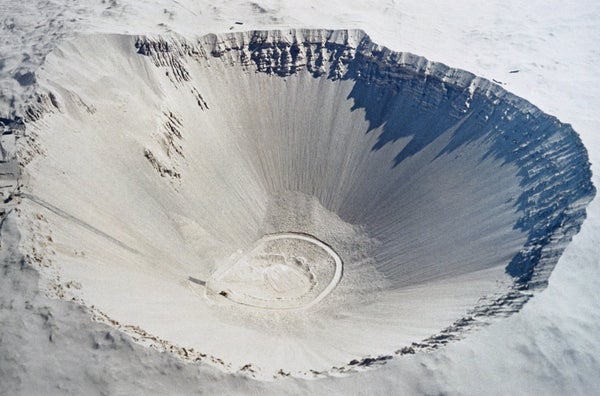

Other rocky planets in our solar system show a common feature: within giant craters caused by impacts there’s evidence of volcanic activity. Which made scientists wonder—can big impacts actually cause volcanic eruptions? And has that scenario ever happened here? To find out, scientists went to one of the few massive craters on Earth not erased by plate tectonics: the Sudbury crater in Canada.
“Sudbury is a 1.85-billion-year-old impact structure.”
Teresa Ubide, a geochemist at the University of Queensland in Australia.
On supporting science journalism
If you're enjoying this article, consider supporting our award-winning journalism by subscribing. By purchasing a subscription you are helping to ensure the future of impactful stories about the discoveries and ideas shaping our world today.
“[Sudbury] was generated when a bolide of 10 to 15 kilometers in diameter hit Earth…and what happened was it obviously generated a large basin and also it melted the…crust on top of the Earth at that time. And generated a massive melt pool, 2.5 kilometers in depth.”
But Ubide and her colleagues found that the impact did more than that: it also seems to have triggered eruptions of magma that came from deep in the mantle. The evidence lies in the fact that the chemistry of the lava that erupted at Sudbury changed over time. At first, it matched the surface rocks, suggesting it was just from local melting. But as the eruptions continued, the lava appeared to come from deep in the mantle, suggesting the impact stirred things up inside the Earth.
No one knows yet exactly how the impact could have sparked a prolonged episode of volcanism. One possible explanation is that after the object smashed into the surface, the crust would have rebounded upward, temporarily decompressing the mostly solid mantle and causing it to melt and produce magma. The results are in the Journal of Geophysical Research: Planets. [Teresa Ubide et al., Protracted volcanism after large impacts: Evidence from the Sudbury impact basin]
It’s hard to know if the same thing happened on other planets, Ubide says. In many spots in the solar system it looks like volcanism happened much longer after the impact than what she saw at Sudbury. But without material to examine directly, we can’t be sure.
Nevertheless, these results do help explain a mysterious chapter in Earth’s own history. Most major impacts on our planet happened about four billion years ago, when the solar system was still settling down. But there’s no crust around from that time, suggesting the entire planet got a makeover soon after.
“We’re suggesting that impacts are able to not only generate the crater, but also, generate melting deeper, say, in the mantle, and bring to the surface material from depth. So actually, recycle and resurface.”
It seems the pummeling that Earth endured in the beginning may have triggered volcanic activity that helped wipe away the evidence of those very impacts. In other words, our planet took a beating that may have accelerated its own recovery.
—Julia Rosen
[The above text is a transcript of this podcast.]
