
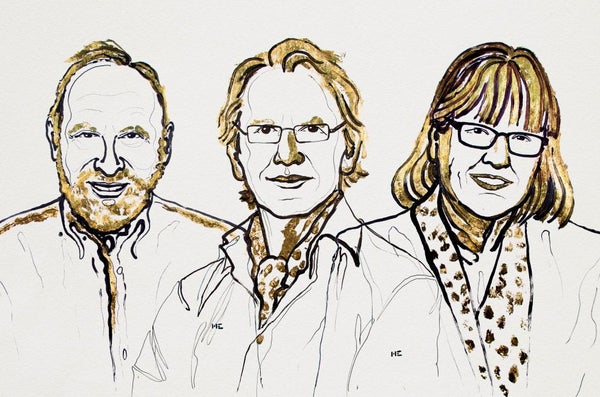

“This year’s prize is about tools made from light. The Royal Swedish Academy of Sciences has today decided to award the 2018 Nobel Prize in Physics with one half to Arthur Ashkin for the optical tweezers and their application to biological systems and the other half jointly to Gérard Mourou and Donna Strickland for their method of generating high-intensity, ultra-short optical pulses.
Göran Hansson, secretary general of the academy, earlier today. And I’m Steve Mirsky. Welcome to Scientific American’s Science Talk, posted on October 2, 2018.
Ashkin’s optical tweezers are the real life version of Star Trek’s tractor beams—although they’re capable of grasping and manipulating only very small objects, like a single cell, not a whole shuttle craft. And the optical pulses of Mourou and Strickland have made numerous applications possible, notably laser eye surgery. What follows is an edited version of the announcement and press conference.
On supporting science journalism
If you're enjoying this article, consider supporting our award-winning journalism by subscribing. By purchasing a subscription you are helping to ensure the future of impactful stories about the discoveries and ideas shaping our world today.
“And with me here on podium is, to my right, Professor Olga Botner, the chairman of the Nobel Committee for Physics, and on my left side, Professor Mats Larsson, who is the member of the committee and an expert in the field of this year’s prize…
“Arthur Ashkin was born in 1922 in New York City. He made his remarkable invention at the Bell Laboratories in New Jersey in the United States. Gérard Mourou was born in 1944 in Albertville in France. And he’s currently at the École Polytechnique in Palaiseau in France, and also affiliated with the University of Michigan in the United States.
“Donna Strickland was born in 1959 in Guelph, Ontario, Canada, and she’s currently at the University of Waterloo in Canada. Drs. Mourou and Strickland did much of their groundbreaking work together at the University of Rochester in the United States.”
REST OF ANNOUNCEMENT AND PRESS CONFERENCE
Following the announcement and press conference, Swedish journalist Joanna Rose spoke with Mats Larsson about the Nobel-winning research.
LARSSON INTERVIEW
We’ll be back tomorrow with coverage of the Nobel Prize in chemistry. We leave you with music from the 2015 International Year of Light global initiative. New Nobel Laureate Gérard Mourou is a composer and contributed some of the lyrics for this piece. Along with Jérôme Musiani, Vince McClenny. That’s Vince McClenny performing.
