
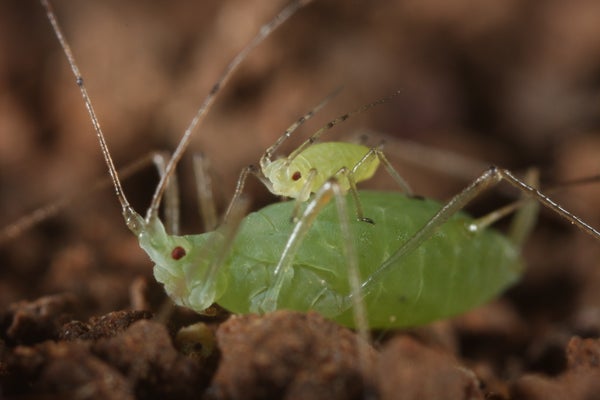

Imagine you're an aphid, a tiny insect that sucks plant sap for a living. You’re munching away when a cow comes along to munch on the same plant you’re on. You feel its warm breath. So you drop to the ground to avoid being eaten and run away.
The ground is a scary place for an aphid, but it’s better than a cow’s mouth. But if you're an especially small, young aphid, also known as a nymph, scampering over cracks, stones and twigs is really difficult.
Luckily, young aphids have a solution. They climb aboard the back of a larger aphid that’s also making an escape and hitch a ride, cowboy style.
On supporting science journalism
If you're enjoying this article, consider supporting our award-winning journalism by subscribing. By purchasing a subscription you are helping to ensure the future of impactful stories about the discoveries and ideas shaping our world today.
“Sometimes there's a pile of nymphs at the beginning that climb on the adult, sometimes even eight or nine nymphs that all climb on the adult."
University of Haifa entomologist Moshe Gish.
Thanks to a series of experiments, Gish learned that the nymphs actively seek out adults after dropping to the ground. It's not that they just try to climb onto any old thing they find nearby.
For the adults, the nymphs are a bit of a nuisance.
"There is some disadvantage for the adult. It slows it down.”
The grownups try to toss off their riders, like a mechanical bull at a college bar. And they’ll toss off a relative just the same as they will an unrelated nymph. But somehow, evolution has allowed this piggyback riding behavior to persist.
"Probably the cost that the adult pays for that delay is not high enough to balance the benefit that the colony gets from saving a few nymphs."
In other words, the advantage to the younger bugs outweighs the cost imposed on the older ones. The entire colony benefits. The results are in the journal Frontiers in Zoology. [Moshe Gish & Moshe Inbar, Standing on the shoulders of giants: young aphids piggyback on adults when searching for a host plant]
Aphids are some of agriculture's most important pests, but to Gish they are also a part of a fascinating, important ecosystem.
"Most people think of aphids—if we think of aphids—they think of aphids as tiny dots on their plants that kill off their plants. But there's a whole world there…all the interactions with the host plants and there’s a chemical warfare between aphids and their host plants. It’s coevolution and it’s an arms race. There's a lot of action going on between the aphids and the plants, and the aphids and their predators, and the aphids and the elements. It's a whole world."
—Jason G. Goldman
[The above text is a transcript of this podcast.]
