

“Legislation to restrict the current overuse, I would say abuse, of antibiotics by farmers who raise livestock for human consumption.”
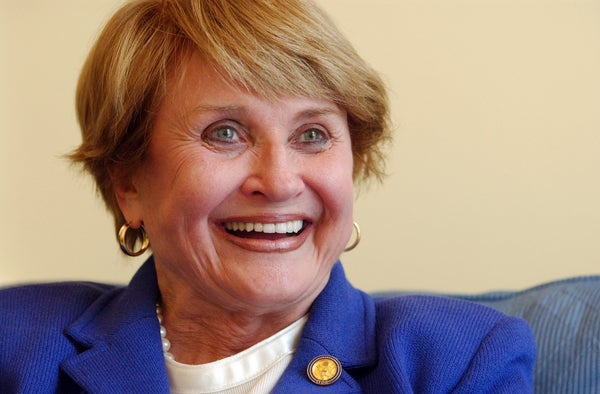
Louise Slaughter, member of Congress from upstate New York, in 2009 on the floor of the House. Slaughter died March 16th. She was 88, and the oldest current member of Congress at the time of her death. More of her 2009 remarks:
“We have legislation that has strong and growing numbers of supporters who, like me, worry that the use of non-therapeutic antibiotics in our food supply poses an enormous and growing health risk for all Americans. And I hope all my colleagues…will be with us when we take up the Preservation of Antibiotics for Medical Treatment Act.”
On supporting science journalism
If you're enjoying this article, consider supporting our award-winning journalism by subscribing. By purchasing a subscription you are helping to ensure the future of impactful stories about the discoveries and ideas shaping our world today.
Slaughter grew up in Kentucky and received a bachelor’s degree in microbiology and a master’s in public health, both from the University of Kentucky. She repeatedly introduced legislation to cut down the overuse of antibiotics to promote animal growth, a factor in driving the development of antibiotic-resistant disease. Maryn McKenna talked to me about Slaughter last fall when McKenna’s book Big Chicken came out:
MM: “Every term she brings forth a bill that is known as PAMTA, the Preservation of Antibiotics for Medical Treatment Act, that would remove from agriculture any antibiotic that is also used in human medicine. And every year the bill doesn’t even get as far as hearings. And every year she brings it back again. She is indefatigable.”
Despite the failure to pass the legislation, Slaughter’s attention to the issue played a role in the decision by various agricultural enterprises to voluntarily cut their use of nonveterinary antibiotics in recent years. You can hear more about that development on the podcast with McKenna on the Scientific American Web site.
Slaughter proposed additional legislation to protect the food supply in general. She was the driving force behind the 2008 Genetic Information Nondiscrimination Act, which prevents insurance companies and employers from using genetic predispositions to discriminate. She also was a leader behind the 1994 passage of the Violence against Women Act, which funded shelters and educational programs. She was in her 16th term in Congress when she died.
LS: “Let’s start taking steps to make sure our food supply is safe as it can be.”
—Steve Mirsky
[The above text is a transcript of this podcast.]
