

“Early in August…the New York Times revealed that Coca-Cola was funding an organization based at the University of Colorado, the Global Energy Balance Network, that was doing research to demonstrate that it really didn’t matter how much soda you drank or what you ate, what really mattered was how much exercise you did, in obesity.”
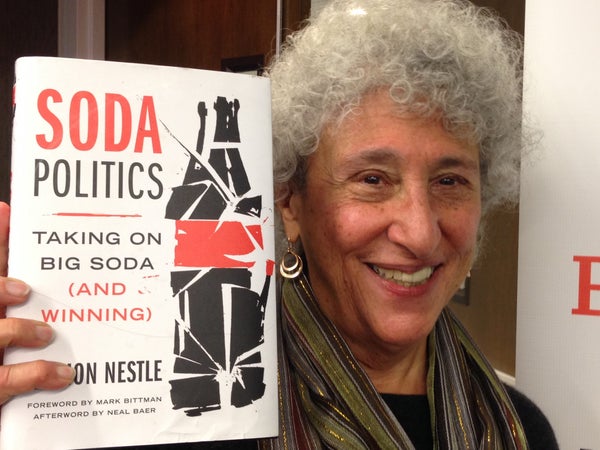
Marion Nestle, professor of nutrition, food studies, and public health and of sociology at New York University, and author of the new book Soda Politics: Taking on Big Soda (and Winning).
“Yes, exercise is very important and I’m for it, but if you want to manage your weight you really, really really have to eat less, and drinking less soda is a good way to start.”
On supporting science journalism
If you're enjoying this article, consider supporting our award-winning journalism by subscribing. By purchasing a subscription you are helping to ensure the future of impactful stories about the discoveries and ideas shaping our world today.
Nestle spoke at an event December 14th sponsored by the New York City Food Policy Center at Hunter College that took place at the City University of New York School of Public Health in Harlem.
“The idea that Coca-Cola would fund this kind of research, that researchers would take money from Coca-Cola to do this kind of research and that the university would allow its researchers to take this kind of money shocked the public…even Fox News was shocked…
“So the fallout…has been amazing to watch…this was a public relations disaster for the company…the University of Colorado returned a million-dollar grant to the Global Energy Balance Network. In November, just a few weeks ago, the Associated Press got involved in this, and they filed government records requests from Colorado to get the emails between the researchers and Coca-Cola, and discovered that Coca-Cola was intimately involved in the research that was being produced by these investigators...
“And in the articles about this it explained that Dr. Rona Appelbaum, who’d been with Coca-Cola for a very long time and has worked with the food industry forever, helped picked the group’s leaders, create its mission statement and design its website. It also was intimately involved in deciding what kind of research was being done and in dealing with the publication of that research—one of the first examples that I’ve been able to find of public evidence that food companies that sponsor research are actually involved in the research…
“December 4th, Coca-Cola said it would no longer fund the Global Energy Balance Network. And the Global Energy Balance Network went out of business.”
More of Nestle’s full talk will appear on an upcoming episode of the Scientific American podcast Science Talk.
—Steve Mirsky
[The above text is a transcript of this podcast.]
