
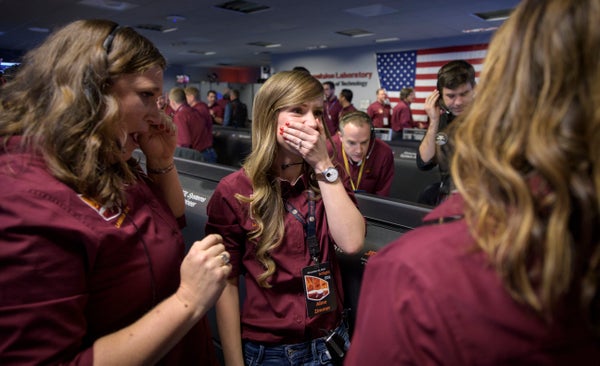

“InSight has passed through peak deceleration, telemetry shows the spacecraft saw about eight G’s.” “Radio science reports carrier detected.” [Applause] “InSight is now traveling at a velocity of 2,000 meters per second.”
Audio from the control room of the NASA InSight Mars Mission earlier today, as the spacecraft landed on the planet after a voyage of six months and 300 million miles. It’ll be sending a probe some five meters below the Martian surface to measure heat flow and listen for tremors. Most of the talking is by Christine Szalai of NASA’s Jet Propulsion Laboratory.
“InSight is now traveling at 1,000 meters per second. Once InSight slows to about 400 meters per second it will deploy its 12-meter-diameter supersonic parachute. The parachute will deploy nominally at about Mach 1.7.”
On supporting science journalism
If you're enjoying this article, consider supporting our award-winning journalism by subscribing. By purchasing a subscription you are helping to ensure the future of impactful stories about the discoveries and ideas shaping our world today.
31 seconds pass
“Ground stations are observing signals consistent with parachute deploy.” [Applause] “Telemetry shows parachute deployment. Radar powered on. Heat shield separation commanded.”
22 seconds pass
“We have radar activation where the radar is beginning to search for the ground. Once the radar locks on the ground and InSight is about one kilometer above the surface, the lander will separate from the back-shell and begin terminal descent using its 12 descent engines.”
27 seconds pass
“Altitude convergence, the radar has locked on the ground.” [Applause] “Standing by for lander separation…lander separation commanded, altitude 600 meters…gravity turn, altitude 400 meters…300 meters…200 meters…80 meters…60 meters…50 meters, constant velocity…37 meters…30 meters…20 meters…17 meters, standing by for touchdown…”
It won’t be until about 8pm Eastern time that NASA knows if InSight’s solar panels are out and working correctly. They needed to literally wait for the dust to settle from the landing before deploying the panels.
“Touchdown confirmed, InSight is on the surface of Mars.”
—Steve Mirsky
[The above text is a transcript of this podcast.]
