
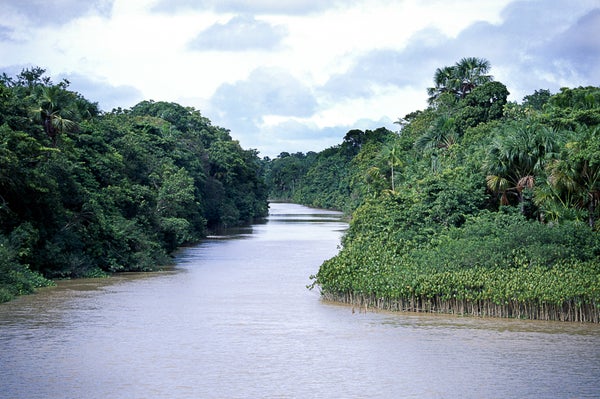

Some 12 percent of the forests of the Amazon have been lost in recorded history. Another 9 to 28 percent will be gone by 2050. But we have not known which species of trees are taking the biggest hits. In part because it’s so difficult to do the fieldwork involved in species surveys.
Now, in a massive effort, a team of more than 158 researchers studied 1,200 plots of trees in the Amazon. They estimated the effects of deforestation on 5,000 species and modeled the impact of deforestation on some 10,000 more.
“With the business as usual scenario, roughly half of the Amazon will be deforested in 2050, leading to similar losses in mean species abundances.” Hans ter Steege of Utrecht University in the Netherlands, one of the study participants.
On supporting science journalism
If you're enjoying this article, consider supporting our award-winning journalism by subscribing. By purchasing a subscription you are helping to ensure the future of impactful stories about the discoveries and ideas shaping our world today.
The findings mean that 36 to 57 percent of Amazon trees could qualify for the International Union for the Conservation of Nature’s red list of threatened species, including the commercially valuable Brazil Nut and Cacao.
Nigel Pittman of Chicago’s Field Museum also worked on the study. “If we were to put on the red list all of these Amazonian trees that aren’t currently listed but probably deserve to be, that would increase the total number of threatened species on Earth by about a quarter, about 22 percent.” The research is in the journal Science Advances. [Hans ter Steege et al, Estimating the global conservation status of over 15,000 Amazonian tree species]
But there is some good news. Government actions could slow the rate of deforestation. Also, deforestation has decreased in recent years. And half of Amazonian forests already lie in protected areas.
ter Steege: “Thus, if we can protect these areas from threats they face, such as fires, degradation, deforestation, large-scale damage, and mining, the Amazon could be a showcase of large-scale conservation worldwide.”
—Cynthia Graber
[The above text is a transcript of this podcast.]
