

Steve Mirsky: Welcome to Scientific American's Science Talk, hosted on November 15, 2015. I'm Steve Mirsky. On this episode:
Arthur Benjamin: I think a lot of the fun stuff has been taken out of the math curriculum with all the emphasis these days on testing accountability. I want people not just to learn mathematics. I want people to love mathematics.
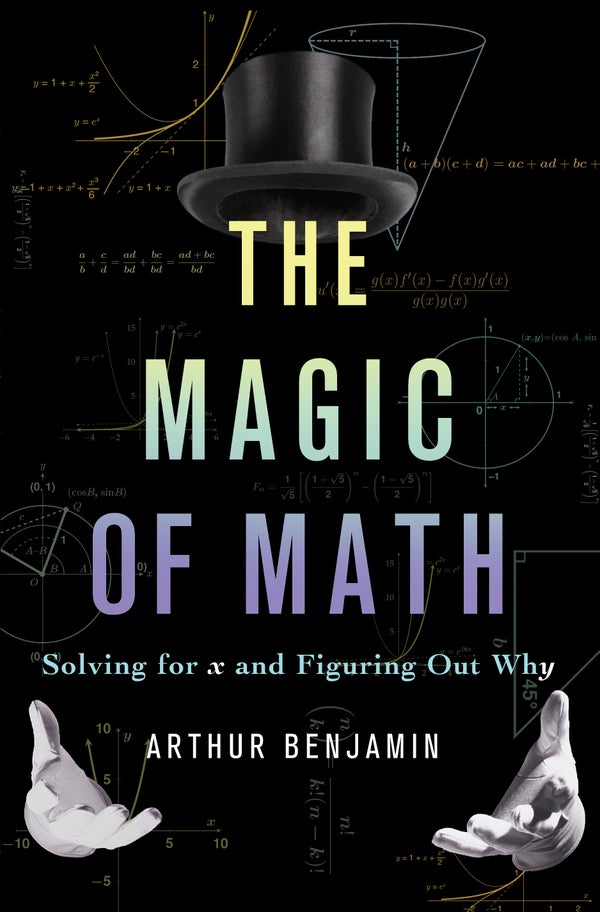
That's Arthur Benjamin. He's the Smallwood Family Professor of Mathematics at Harvey Mudd College in Claremont, California. You may know him from his three Ted Talks, which have been viewed more than ten million times. He's been the editor of Math Horizons Magazine published by the Mathematical Association of America, and he is the author of the new book, The Magic of Math – Solving for X and Figuring out Why from Basic Books. He was recently in New York City on a book tour and we spoke at the Scientific American offices.
On supporting science journalism
If you're enjoying this article, consider supporting our award-winning journalism by subscribing. By purchasing a subscription you are helping to ensure the future of impactful stories about the discoveries and ideas shaping our world today.
Mirsky: You talk in the book – you have this one example – there are many fascinating examples in the book that illustrate your point about the magic of math. We should say this is for Scientific American and your hero was Martin Gardner.
Benjamin: Absolutely. Martin Gardner was the original “mathemagician”—and the best. He had a way of explaining mathematical concepts and scientific concepts in a way that was clear, and fun, and just so engaging, and inspired thousands of young mathematicians and budding scientists through his writing and books.
Mirsky: And all of his stuff is available in our digital archive now. Now that I've gotten that commercial out of the way…
Benjamin: And so appropriate, too. Absolutely.
Mirsky: Because you talk about him in the book. One example really jumped out at me. You talk about a football field. An American football field is 100 yards plus ten yards for each end zone. The goal posts are at the end of the end zone, so if you tied a line – a rope – taut from one goal post to the other goal post, it would be 360 feet.
Benjamin: 120 yards. 360 feet.
Mirsky: But then you talk about – you're illustrating a point here – if you add one foot of line to the rope –
Benjamin: Right, just a little bit of slack.
Mirsky: So the rope is now 361 feet long. When it was 360, you couldn't pick it up at all.
Benjamin: An ant could not crawl underneath that rope.
Mirsky: So now it's 361 feet and the question in the book is…
Benjamin: You go to the 50-yard line and you lift the rope as high as you can. How high can that rope be lifted? Can an ant crawl under it? Could you crawl under it? Could a truck drive under it? How much room do you have at that 50-yard line?
Mirsky: Before we give the answer away – and some of these concepts are going to be much easier to visualize if you're actually reading the book or if you're sitting there with a pencil and paper and you just scrawled – just draw a triangle. We're making a triangle. When you pull that, we're making two triangles when you pull the rope up.
Benjamin: That's right. If you think of it, if you pull it straight up, you have two right triangles. Just focus on one of those triangles, say from the 50 yard line all the way to one of the goal posts. The base of it is still 180 feet, but now the hypotenuse – the diagonal part – is, let's see. It would be not 181 but 180.5 because you had one extra foot that went across the whole football field. So you have 180 across.180.5 on the diagonal – the hypotenuse. Even here you might think, "That couldn't go very high, could it?" And yet, the Pythagorean theorem, one of the most important theorems in mathematics says that that height – let's call that H – has to satisfy H squared plus the base squared – 180 squared – has to equal that 180.5 squared. And when you solve for H, you get something like 13 feet or so.
Mirsky: It's a little more than 13 feet. There were a couple of things that came up when I read that. One was, that's impossible. The other was – and this is what's so wonderful about math. The other thing that came up for me was, that's just the way it is. You can't argue with it. It's just the equation is infallible and it has to be true.
Benjamin: That's the beauty of mathematics. It's rarely up for debate. Things are true or they're not and you rarely have differences of opinions of whether a mathematical fact is true or not.
Mirsky: The other thing that freaked me out about it was, then I thought about it works just as well if instead of pulling it up – instead of pulling the lineup – you pulled it toward one of the sidelines. You'd get exactly the same result, but the difference between the apex of the pulled cord and the middle of the field is now also 13 feet because you could do a –
Benjamin: It's the same right triangle. That's right.
Mirsky: What that means is, let's say some guy takes a kickoff at the end of the end zone and instead of running right down the field, takes a path that detours 13 feet from the center of the field and then back so that he winds up at the other goalpost. He's only added one extra foot to his run and that's also so counterintuitive.
Benjamin: That's right because you saw him 13 feet away from the center of the field, and yet the total length that he ran was only one foot longer. Isn't that amazing? Even hearing that, I think that feels so unintuitive, and yet that's part of the beauty and pleasure that mathematics can bring is discovering things that seem wrong yet are right. You can understand why they're right and why it happens.
Mirsky: And I guarantee – anybody out there who doesn't believe it, if you ran the experiment it would turn out that the professor here is correct. You have a similar kind of example in a later chapter where you have a rope going around the whole planet –
Benjamin: Right. Say, around the equator of the earth.
Mirsky: Let's just round it off. We'll say it's 25,000 miles around. We'll assume a completely spherical earth, and flat. There's no mountains and the water isn't going to change the rope. And then we add ten feet to the rope. Now how high above the equator, all the way around the planet, could you pick the rope up?
Benjamin: So now you say, "I'm just going to lift that rope up. I'm going to put them on pegs or something so that it hovers around the equator." How high does that extra ten feet of rope – ten feet. It's what? Ten feet over two pi, about one and a half feet. You could crawl under that rope. It turns out to be an elementary consequence of the formula for the circumference of a circle, two pi R.
Mirsky: And bot only that, it's the same one and a half feet. Really it doesn't matter what the original circumference is.
Benjamin: That's right. You would get the same answer if we put the rope around a basketball or the sun. The number 25,000 doesn't actually play a role in the answer. Again, it's paradoxical yet true.
Mirsky: The 25,000 falls out when you actually do the calculations. There's a lot of fun stuff in the book like that.
Benjamin: Thank you.
Mirsky: Why did you write the book?
Benjamin: I think a lot of the fun stuff has been taken out of the math curriculum. With all the emphasis these days on testing and accountability, we wind up emphasizing to our students a smaller and smaller body of material that's been deemed important. The problem with that is, a lot of the joy has been taken out of that material. And some of the material that's just mind blowing like the ones we've described, they just don't appear anyway. They had to be cut out so as to make the students master that smaller body material better, and that's unfortunate.
I want people not just to learn mathematics. I want people to love mathematics. That's what Martin Gardner's writing did for me. Like, "Wow, this is cool." People don't become scientists and mathematicians because they got really good at doing the multiplication of numbers or long division algorithm. That doesn't excite anybody. But to see these surprises and these things that tickle the brain, that's what makes somebody passionate about mathematics, and science, and problem solving.
My hope is that this will be a book that people will wish they'd had in school, either because it explained the important stuff clearly and it showed them just fun, bazaar things in a magical way – through magic, through humor, through puns, songs –
Mirsky: Terrible puns.
Benjamin: Thank you. Only with puns to we say if it's terrible it's good. That's the point. Math is fun. It's a serious subject but it doesn't have to be taught in a deadly serious way.
Mirsky: Early on in the book you're talking about, "If I add 3x to 2x, I get 5x."
Benjamin: And my father said to me – this was my first algebra lesson. He said, "Okay, Arthur. What is 5q plus 5q," and I said –
Mirsky: 10q.
Benjamin: And he said, "You're welcome."
Mirsky: And right away, I said, "I'm going to like this book," because that's awful and it's great. There was another part of your book – I had seen many of these concepts before, obviously, because I went to high school. But the way you talk about some things makes you think about these concepts differently. And then there were some things that I had never seen. For example, .99999… – which we all know means just nines to infinity forever – equals one. I said, "No, it doesn't equal one. It equals almost one." But then, in a couple of quick steps you prove, no, it does equal one.
Benjamin: And I give you five different ways of proving that those two numbers are the same, and mathematicians have important reasons for calling those things the same. Maybe the easiest way is if you think of a third, do you agree that a third is .33333 forever? Now multiply that by three and you'll get three thirds, which is one, but you'd also get .99999 forever. So they are mathematically the same.
Mirsky: It's a little disturbing but it's also pretty interesting.
Benjamin: At any time, infinity gets brought into the equation – and here we have infinity in the form of infinitely many dots, infinitely many nines – that's when the mathematics gets really interesting and sometimes paradoxical. In mathematics, the commutative law says that a+b = b+a. The order in which you add numbers doesn't matter. Well, guess what? If you're adding an infinite number of numbers, you can get a different total if you add them in a different order. That's just bazaar that the order in which you add the numbers can make a difference as to what the final total is.
Mirsky: Right, and that's a little too complicated, probably, to get into here, but it's in there.
Benjamin: But it's there. I want this book to be read multiple times. It's written in several different levels. If at any point you get stuck, I say just keep on going. I just don't want you to stop. There's fun stuff and the last chapter is about infinity. Because you can't go past infinity, I had to stop there. There's some mind-blowing things there. It also sometimes makes use of things that were learned earlier. That can sometimes be the motivation to go back and understand the stuff that was there earlier.
Mirsky: I took your advice. You said, "Whatever you do, feel free to skip but read the last chapter."
Benjamin: Read the last chapter. There's a lot of stuff that's in little gray boxes. I say you should probably skip those the first time, but maybe the second or third time that you read it – and I hope you do re-read it because that's mathematics for you – then you'll say, "Oh, I think I'm ready for this now. Maybe now this will make more sense to me." And people who are advanced, like many of the Scientific American readers, might find that the gray boxes are their favorite parts of the book and they're ready for it right now. I'm really aiming at a very broad audience, from people who approaching high school level math for the first time to people who have forgotten most of their high school level math.
Mirsky: I took my SATs 40 years ago, so if I had to look at those SAT problems again, they would probably be pretty challenging. The stuff in here brought back a lot of the thinking. I was remembering I really liked geometry. This is Euclidian geometry, plain geometry. How could you go wrong? You can't go wrong. There are rules and so you know if you draw those intersecting lines you know for sure that the angles on opposite sides are going to be equal. There's no way around it.
Benjamin: And Euclid knew that thousands of years ago. It's just as true today as it was then. I've always thought that the best path towards becoming immortal would be to discover a new mathematical theorem, and if you can, have it named for you and then your name will be out there forever.
Mirsky: Right, like Pythagoras and, uh…
Benjamin: And Euclid, and Fermat, and Newton, and Archimedes, and Gauss, and Euhler.
Mirsky: I always go for thousands of years, so two people so far.
Benjamin: Hero makes an appearance in the book, but…
Mirsky: There's another really fascinating example that I had never been exposed to and that's, you had playing cards. Cards are really always fun for talking about probabilities. Anybody who has played any poker, you know the standard order of what beats what – high card, one pair, two pair, three of a kind, straight, flush, full house. But if you add the jokers, the rules go out the window.
Benjamin: The reason the hands are ranked in the order that they are is they're ranked according to what is harder to be dealt. It's much less likely to be dealt four of a kind than it is one pair, therefore the four of a kind is worth more than one pair. It's harder to be dealt a flush than it is a straight, and that's why the flush beats the straight. But now if you introduce wildcards into the picture, now you might have a choice of, do you use that wildcard – let's say you have a choice between making your hand two pair or three of a kind, as you could if you had a joker.
Say you had a pair and two other cards, and now the joker comes in. Do you use that joker to match your pair, or do you use that joker to match one of the other cards? You're going to do whichever one is the more valuable hand. If three of a kind is more valuable, then you'll use it to match the pair. But guess what? By doing it that way, three of a kinds now become more common than two pair, and therefore they should be less valuable than two pair. But then you could use those jokers in exactly the opposite way so there is no consistent way of ordering your hands.
Mirsky: That was really amazing to me. You begin the book – I'm sure a lot of people listening – this story about Gauss is one of the most famous stories in the history of math. But anybody who doesn't know it should hear it, so why don't you tell it?
Benjamin: Okay. Gauss, when he was a young boy, his teacher asked the classroom to add up the numbers from 1 to 100 while the teacher presumably was going to take a coffee break. Gauss immediately gave the answer and said, "It's 5,050," except he said it in German. The teacher said, "Yes, that's right. How did you do that?"
How Gauss probably did it was this. He said, "Well, imagine the numbers 1 to 100. Let's say 1 to 50 written in one big row from left to right, and then 51 to 100 written beneath it but write those numbers from right to left." So you have a one, and below that you have 100. Those numbers add up to 101. Next, you have 2, and underneath that, 99 and those numbers add up to 101. Then 3 plus 98 is 101. Take it all the way to the right where you have 50 plus 51. That's 101. So Gauss could see that these numbers were collapsed into 50 pairs of numbers that each added up to 101. And if 5 times 101 is 505, 50 times 101 is 5,050 and that was Gauss's answer.
Gauss was probably pretty quick at doing mental sums, but he got that answer not by adding the numbers we would. What Gauss was able to do better than just about any mathematician in history was his ability to make numbers dance and to see numbers, and geometry, and algebra in ways that nobody had seen before. He was a true genius.
Mirsky: When he did the 50 50 example, how old was he?
Benjamin: He was probably – I think he was about ten years old or so. He got the attention of some patrons. He grew up in a poor family and these patrons subsidized his education so that he got the mathematical training that he deserved.
Mirsky: There's a really, I think, important part of the book. A lot of the book is fun and instructive, but there's an important part of the book where you talk about how you can just eyeball some data to know more or less what is possible as an answer.
Benjamin: Oh, yes. I spend a little bit of time talking about mental approximation. We spend a lot of time in schools teaching students how to get the exact answer, yet if I asked a random student or even a random teacher, "What do you get when you multiply a four-digit number times a six-digit number? How many digits are in the answer?" People don't know. They can go through the algorithm if you give them the numbers, but what's the answer? The answer turns out to be ten digits, or nine because four digits plus six digits is ten digits. When you multiply numbers, you get the sum of their digits or one less.
How about division? If I take a six-digit number divided by a four-digit number, how big is the answer? It's two digits or three digits. Six minus four is two or one more. So it's two or three digits. That's way more important than knowing what the first digit of the answer is. Way more important is to know, how big is the answer? Is the number in the hundreds or is it in the thousands? There are some very simple rules out there that because we don't really properly emphasize mental math in our school that are not shown to our kids. That's a practical result.
Mirsky: Right. This is the kind of thing that's going to come up if you're shopping and something is 40 percent off. You don't have to figure out exactly how much the new price is going to be, but you should be able to generally know that if it started out – and I'm going to use really easy numbers here. If it started out at $100.00 and it's 40 percent off, you're going to know that it's not less than $50.00. It's still more than $50.00.
Benjamin: Right. It's so important to have an intuitive sense of what the answer should be, especially when you look at enormous numbers. If something is going to cost tens of billions of dollars, let's say –
Mirsky: An aircraft carrier.
Benjamin: You say, what is that? That's 11 digits. We're going to divide that by the 300 million people in this country. Okay, so that's nine digits. Then that's telling us it's costing every person two digits or three. It's in the order of tens or hundreds of dollars per person. You then take that information for what it's worth, but that's something that people just – they see numbers and they tend to close their minds. They just stop thinking. Or, they pull out the calculator and if the calculator is there then they won't think about it. I'd like people to use their minds more.
Mirsky: I think you mention it in the book, but you have a favorite number – just a four-digit integer.
Benjamin: Yeah. My favorite four-digit number is 2,520.
Mirsky : Why is that again?
Benjamin: In fact, if you look in the index of the book and you look under My Favorite Number, instead of a page number it says 2,520. Underneath it says why and then I give the page number that will explain that, but I'll tell you here. As a kid, in fact, it was my favorite number. The reason was that it was the smallest number that was divisible by all the numbers from one through ten. So you look at a number like 60. That's divisible by most of the numbers from one through ten, but it's not divisible by seven, say. So 2,520 was the smallest number. By an amazing coincidence, the house number that I grew up in was 1260, which was half that number. That was divisible by all the numbers from one through ten except for eight.
It's okay to have favorite numbers. People have favorite colors and favorite celebrities. Why not favorite numbers?
Mirsky: Everybody has this feeling because everybody loves to watch the car odometer turn when you get to a milestone number. Everybody has this strange impulse to have a connection to a number, I think.
Benjamin: Absolutely. My older daughter, she was into palindromic numbers. Anytime a number would show up and it was a palindrome. This year, for example, on the Hebrew calendar – we just went from the year 5775, which is a palindrome, to 5776, which is a perfect square. Ooh, I know. Right? It's 76 squared. 76 times 76 is 5776, and get this. 5776 ends in 76. So not only is it 76 times 76, it ends in 76 and that's the only four-digit number that has that property, that when you take the square root you get the last two digits of the number.
Mirsky: Wow. I'm sure there are numerologists out there who have figured out why this means something important.
Benjamin: And it's rare. You won't see this happen again. You won't see a perfect square year in the Hebrew calendar for another 153 years when it's 77 squared, which of course we can now do, is 5,929. Or at least you can do that when you read the book.
Mirsky: This is good stuff. I remember having a conversation with my mother many years ago and the clock – it was a digital clock – came up and it was 12:34. She notices it and she said, "12:34. That's my favorite number on the clock." I was like, "That's my favorite number." We bonded over this wacky affection for this digital clock number.
Benjamin: I'm going to tell you something that I just learned two days ago, and I'm serious. It's not in the book. I wish it was, though. I put my mother's birthday in the book. I teach you how to create a magic square out of anyone's birthday. I decided to celebrate my mother's birthday. She was born in 1936. My mother has always had a passion for the number four. In fact, her email address ends with 44 in it, as a way of celebrating the number four. As it turns out, 44 squared is 1936. She was born in the only perfect square year of our century and it happened to be 44 squared, which has always been her favorite two-digit number. I never made that connection. She just made that connection recently and said, "Why didn't you tell me this?" I said, "I didn't know until now. This is wonderful."
By the way, I am not a numerologist. I take all that stuff in the same way that people will play with the digits of pi and such. It's fun to do that. We'll celebrate Pi Day on March 14 and that's great. I do worry sometimes that people will use numbers in ways that they're not designed for – for astrological readings, and picking lottery numbers, and things like that. Then I think you're actually hurting mathematics a little bit. That's not what numbers were meant to do.
Mirsky: There's a wonderful ending to a Woody Allen short story where he talks about some numerology where people are trying to decipher the nature of reality by pulling numbers out of the number of letters and certain words in the bible. He says it was logic like this – this is a paraphrase, unfortunately. I don't have it committed to memory. "It was logic like this that led the rabbi to win the daily double 22 days in a row at aqueduct and still lose money." We can take that for what the numerology is actually worth, but we're talking about real mathematics in this book. It's really fun stuff, and 5q plus 5q.
Benjamin: Well, you're welcome.
Mirsky: The exact Woody Allen line is, "It was reasoning like this that led Rabbi Yitzhak Ben Levy, the great Jewish mystic, to hit the double at aqueduct 52 days running and still wind up on relief." That's from his short story, "Hasidic Tales with a Guide to their Interpretation by the Noted Scholar" originally published in The New Yorker in the June 20, 1970, issue and reprinted in a collection called Getting Even.
That's it for this episode. Get your science news at our Web site, www.scientificamerican.com, where you can check out the newly published December issue of the magazine. The cover story is on world changing ideas. The good ones, too. Not the crummy ones. And follow us on Twitter where you'll get a tweet whenever a new item hits the Web site. Our Twitter name is @sciam. For Scientific American Science Talk, I'm Steve Mirsky. Thanks for clicking on us.
[End of Audio]
