

Sometimes discoveries seem so simple.
“You know, basically, we found a bunch of holes in the ground.”
That’s Eduard Reinhardt. He’s an archaeologist and geologist at McMaster University in Ontario, Canada.
On supporting science journalism
If you're enjoying this article, consider supporting our award-winning journalism by subscribing. By purchasing a subscription you are helping to ensure the future of impactful stories about the discoveries and ideas shaping our world today.
“But ultimately, very important holes in the ground.”
Reinhardt and colleagues believe they’ve found some of the first clear evidence of mining activity in a system of caves in Quintana Roo on the Yucatán Peninsula. The find dates back to between 10 and 12,000 years ago.
“So these are some of the very early people that have come and migrated to the Americas via the Bering Strait.”
But getting to what remains of these miners and the tools they left is a challenge.
“Like, as cave divers, you gotta be so careful you don’t get lost.”
These cave systems in Mexico, which were once dry, are now completely filled with water, thanks to a warming climate and sea levels that rose over time. Winding passageways are narrow and dark. And the walls are made of unforgiving limestone, porous and with sharp edges. Reinhardt says the water that filled the caves has preserved everything.
“It’s basically almost like somebody working at a factory: they turned the lights off, they went away and nobody ever came back.”
When divers started telling Reinhardt about what they were seeing inside the cave, he decided to go for a dive himself. He found concentrations of charcoal—meaning that the people who walked here thousands of years ago probably used fire to light their way. And there are stone cairns, which Reinhardt believes the people built as navigation markers. Reinhardt also says lots of tools remain. And they were made from the stalagmites that hung from the cave ceiling.
“They were breaking off and then using as hammers. So you can see the percussion marks where they were banging up, breaking up the stone on the bottom.”
The discovery is in the journal Science Advances. [Brandi L. Macdonald et al., Paleoindian ochre mines in the submerged caves of the Yucatán Peninsula, Quintana Roo, Mexico]
So what were these ancient people mining and prospecting for?
“There was a little bit of sediment still on the wall of the pit. So I grabbed a vial, my sample vial, and grabbed some of this sediment. And underwater, the red light gets attenuated, so it looked kind of brown. And I was thinking, Well, maybe it’s ocher. You know, I was thinking about that, but it’s like, Well, it looks kind of cruddy, I don’t think that’s what it is. But then I got out of the cave and into the sunlight, and it was just like this spectacular bright, bright red. So then I knew that that’s what they were after.”
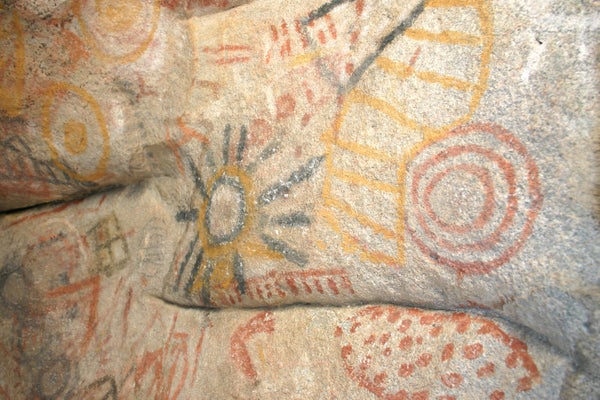
Ocher—it’s among the earliest known pigments employed by humans. And it’s got many uses: for sunscreen, to preserve animal skins, in burials and ceremonies. And people still use it, even today, in artwork.
“It’s a prominent and used geomaterial, if you will, throughout the time period. And dates to usage for thousands of years prior to Paleo-Indians around the world.”
—Emily Schwing
[The above text is a transcript of this podcast.]
