
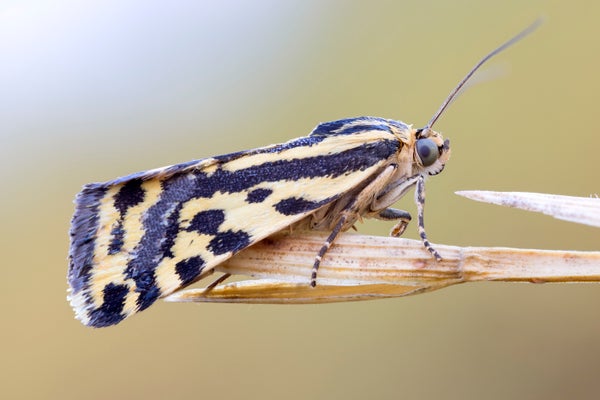

About 12,000 species of tiger moth exist on Earth. Some of them swoop and dive out of harm’s way when a hungry bat tries to make them a meal. But other tiger moth species are more blasé—they just don’t bother to flee from the hungry bats.
“And I really just wanted to know why. Why the difference? What factors might be influencing whether a species is more or less likely to perform these evasive maneuvers?”
Wake Forest University behavioral ecologist Nick Dowdy. He says it’s a matter of taste—some of the moths are delicious, but others are toxic and taste terrible. When the airborne predators catch these unappetizing moths, they’ll spit them out, giving the insects a new lease on life.
On supporting science journalism
If you're enjoying this article, consider supporting our award-winning journalism by subscribing. By purchasing a subscription you are helping to ensure the future of impactful stories about the discoveries and ideas shaping our world today.
In a field experiment, Dowdy and his colleague William Conner filmed how five different species of tiger moths responded to bat attacks.
“And what we found was that those species which were really toxic—so when the bats captured them, they almost never ate them—those species were much more likely to be what we call nonchalant, species that do not perform evasive maneuvers very often. On the other hand, species that were really palatable were much more likely to perform those evasive maneuvers, almost, in a sense, sort of hedging their bets. Because if they don’t make that escape, if they are captured by a bat, those species are more likely to be eaten.”
Another factor is that evasive maneuvers have their own set of risks, which may be why unpalatable moths tend to avoid them. For example, diving away from bats burns fuel, gives the insects less time to seek out mates and could expose them to other perils, such as getting stuck in water.
“Or there could be predators on the ground like mice and other mammals.”
The study is in the journal Frontiers in Ecology and Evolution. [Nicolas J. Dowdy and William E. Conner, Nonchalant flight in tiger moths (Erebidae: Arctiinae) is correlated with unpalatability]
Dowdy is now trying to identify the chemical compounds responsible for making some tiger moths taste bad. Once those findings are in, chemical analysis of museum specimens could help reveal how rare, endangered or even extinct insects have behaved around predators.
“We can still study animal behavior even without a living organism. That’s, I think, pretty amazing.”
Other animals with conspicuous warning signals, such as garishly colored poison dart frogs and foul-smelling skunks are also known to be slow movers. Perhaps if you’re deadly, toxic or just plain stink, it can pay to be lazy.
—Susanne Bard
[The above text is a transcript of this podcast.]
