
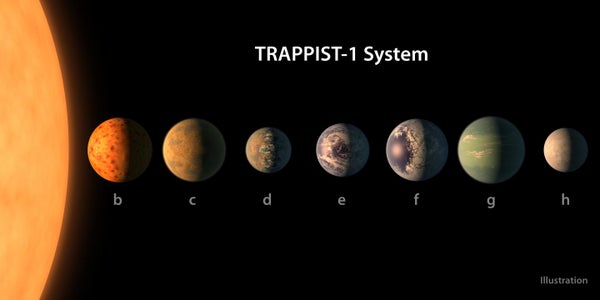

In the last two years, astronomers have found seven exoplanets around the star TRAPPIST-1, only 40 light-years away. As well as a planet called Proxima b, orbiting Proxima Centauri, a mere 4.2 light-years from us.
“I think now that we have these very nearby planets what I’m seeing in the community is all kinds of ingenuity, in terms of designing ground-based telescopes, small space-based telescopes, that are specifically…they’re specifically intended to do just this one job.”
Jill Tarter of the SETI Institute in Mountain View, California. SETI stands for the Search for Extraterrestrial Intelligence. Tarter was the inspiration for the Jodie Foster character in the movie Contact.
On supporting science journalism
If you're enjoying this article, consider supporting our award-winning journalism by subscribing. By purchasing a subscription you are helping to ensure the future of impactful stories about the discoveries and ideas shaping our world today.
“And I’m really amazed at what I’m seeing in terms of what might be possible. Not 20 years from now, but in five years from now. For reasonable amounts of money. So the fact that these planets are now becoming places really is changing the scene.”
Tarter spoke on a panel October 29th at a SETI session at Berkeley that was part of the biannual World Conference of Science Journalists. Also on the panel was Dan Werthimer, chief scientist at the Berkeley SETI Research Center. Who talked about a proposal called Breakthrough Starshot.
“And the idea is to go, and get there in 20 years and take a picture of Proxima b. It’s a one-gram spacecraft. Four meters across. And it’s a sail. And you deploy it in space. And you shine a laser, 50 Gigawatt laser, on it for about two minutes. And in the two minutes it accelerates at 50,000 g's. And gets up to about 20 percent the speed of light. And then it goes there and takes a picture and sends it back.”
If that all worked, we could have a photograph of an exoplanet only 24 years after launch from Earth: 20 years to get there and four years for the photo to arrive. If that does not sound impressive consider that our current highest speed spacecraft would need 30,000 years to reach Proxima b. And I don’t have that kind of time.
—Steve Mirsky
[The above text is a transcript of this podcast.]
