

“The Royal Swedish Academy of Sciences has decided to award the 2017 Nobel Prize in Chemistry jointly to Jacques Dubochet, Joachim Frank and Richard Henderson…for developing cryo-electron microscopy for the high-resolution structure determination of biomolecules in solution."
Göran Hansson, secretary general of the Academy, at 5:53 this morning Eastern time.
Dubochet is honorary professor at the University of Lausanne in Switzerland. Frank is at Columbia University in New York. Henderson is at the Laboratory of Molecular Biology in Cambridge.
On supporting science journalism
If you're enjoying this article, consider supporting our award-winning journalism by subscribing. By purchasing a subscription you are helping to ensure the future of impactful stories about the discoveries and ideas shaping our world today.
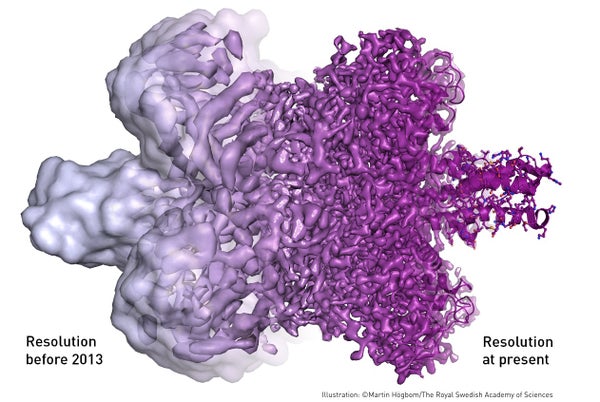
“The technique has transformed electron microscopy from a technique that could be used to just see the shapes, the outer shapes, of molecules into one that is now used to see the details, the atoms inside the molecules.
Peter Brzezinski is a professor of biochemistry at Stockholm University and a member of the Nobel Committee for Chemistry.
“And the latest technical developments occurred very recently. So it’s recent developments that you can actually see the details of these molecules. The technique is also relatively rapid, so once one has samples that can be studied the structure can be determined relatively rapidly. And this was exemplified last year when the structure of the Zika virus was determined in just a few months. And the structure shows the atomic details of the surface, which of course is important when developing drugs against the virus.”
For an in-depth listen about the 2017 Nobel Prize in Chemistry, look for the Scientific American Science Talk podcast later today.
—Steve Mirsky
[The above text is a transcript of this podcast.]
